Table of Contents
Frequently Asked Questions
What details must a UAE tax invoice include?
A tax invoice must show the words "Tax Invoice", the supplier's name, address and Tax Registration Number, a sequential or unique invoice number and the issue date. It must also include a description of the goods or services, the amount excluding VAT, the VAT charged in AED and the total payable. Recipient details are required in specified cases.
Can a company without VAT registration charge VAT on an invoice?
No. Only VAT-registered businesses with a Tax Registration Number can charge VAT and issue tax invoices. An unregistered company should issue a commercial invoice without VAT. Registration is mandatory once annual taxable supplies exceed AED 375,000.
Do invoices in the UAE have to show amounts in AED?
You can price a contract in a foreign currency. The VAT amount on a tax invoice must still appear in AED. Showing the AED total alongside keeps the invoice consistent with your VAT return.
Is a proforma invoice the same as a tax invoice?
No. A proforma invoice is a preliminary document that quotes a sale before it is completed. It does not record a supply and cannot be used to claim input VAT. Issue a tax invoice once the supply takes place and you are VAT-registered.
When should a new business start issuing tax invoices?
A business should issue tax invoices from the date its VAT registration takes effect. Registration is mandatory above AED 375,000 in annual taxable supplies and voluntary from AED 187,500. Before that date, issue commercial invoices.
How do credit notes work in the UAE?
A credit note corrects an issued invoice, for example after a return or a pricing error. It should reference the original invoice number and show the adjusted amount and VAT. Never overwrite or delete the original invoice.
What will e-invoicing change for small Dubai businesses?
E-invoicing moves businesses from PDF or paper invoices to structured electronic formats exchanged through accredited service providers, under the Ministry of Finance framework. Small businesses will need accounting software that can produce and transmit invoice data in the required format. Clean customer and Tax Registration Number records make the transition easier.
How can a Meydan Free Zone company keep invoicing records in order?
Meydan Plus includes mCore for business bank account support and mAccounting for bookkeeping, VAT registration support and Corporate Tax support. Matching each invoice to a ledger entry and bank receipt every month keeps records consistent. Use the details on your Meydan Free Zone Business License on every invoice.
Topic Summary
What Invoicing Means for a UAE Company
Invoicing is the process of issuing a formal document that records a sale, the amount due and the parties involved. For VAT-registered businesses, it must meet Federal Tax Authority (FTA) rules. Unregistered companies still need clear invoices for payment, bookkeeping, banking and audit trails.
Tax Invoice Requirements
A UAE tax invoice must show the words "Tax Invoice" and the supplier's name, address and Tax Registration Number (TRN). It also needs a sequential or unique invoice number, the issue date, a description of the supply, the amount excluding VAT, the VAT charged in AED and the total payable.
How VAT Affects Your Invoices
VAT requires registered businesses to charge 5% on most supplies, show it separately and report it to the FTA. Some supplies are zero-rated or exempt, and the invoice must reflect the correct treatment. Our guide to VAT in the UAE covers the wider system.
Steps to Issue a Compliant Invoice in the UAE
To issue a compliant invoice, confirm your VAT status, choose the invoice type and add all mandatory fields. Then apply the right VAT treatment, number the invoice, send it and record it in your books.
E-Invoicing Changes for Dubai Companies
The UAE is introducing mandatory e-invoicing through the Ministry of Finance, moving businesses from PDF invoices to structured electronic formats exchanged through accredited service providers. Rollout is phased, and the e-invoicing in the UAE overview explains how it applies by business size.
Payment Terms and Late Payment Risk
Payment terms in the UAE are set by contract, not statute, for most B2B sales. State the due date, payment methods, bank details and late-payment consequences on every invoice. Clear terms reduce disputes.
Setup for a Meydan Free Zone Company
A Meydan Free Zone company should set up a bank account, an accounting routine and an invoice template before the first sale. Meydan Plus includes mCore for business bank account support and mAccounting for bookkeeping, VAT registration support and Corporate Tax support. VAT is a federal tax administered by the FTA, so the same registration thresholds apply to a free zone company.
Invoicing Clients From a Dubai Company: Key Points for New Businesses
Most new founders treat an invoice as a polite payment request. Once VAT registration applies, it becomes a regulated tax document. This guide covers what a compliant invoice must show, how VAT changes it and how to set up a clean routine before your first client pays.
What Invoicing Means for a UAE Company
Invoicing is the process of issuing a formal document that records a sale, the amount due and the parties involved. For VAT-registered businesses, it must meet Federal Tax Authority (FTA) rules. Unregistered companies still need clear invoices for payment, bookkeeping, banking and audit trails.
Commercial Invoice Versus Tax Invoice
A commercial invoice requests payment. A tax invoice also carries VAT details. Your registration status decides which one you issue. VAT registration is mandatory above AED 375,000 in annual taxable supplies, according to the FTA.
Say a freelance consultant sits below the threshold and issues commercial invoices. After registering, that same consultant must issue tax invoices. Mislabelling creates problems at filing and during client audits.
Commercial and Tax Invoices Compared
| Feature | Commercial Invoice | Tax Invoice |
|---|---|---|
| Who issues it | Any business not registered for VAT | Any VAT-registered business making taxable supplies |
| VAT shown separately | No, VAT must not be charged | Yes, per line and in total, in AED |
| Tax Registration Number required | No, the supplier has none | Yes, the supplier's TRN must appear |
| Governing rules | Contract terms and general bookkeeping practice | Federal VAT law and Federal Tax Authority requirements |
| Typical use | Early-stage consultants and start-ups below the threshold | Trading, agency and service companies above the threshold |
Why Invoices Matter Beyond Getting Paid
Banks review invoices when assessing account activity. A new trading company may be asked for invoices to justify incoming transfers. The same documents support your VAT and Corporate Tax records, and clean ones shorten payment disputes.
Tax Invoice Requirements
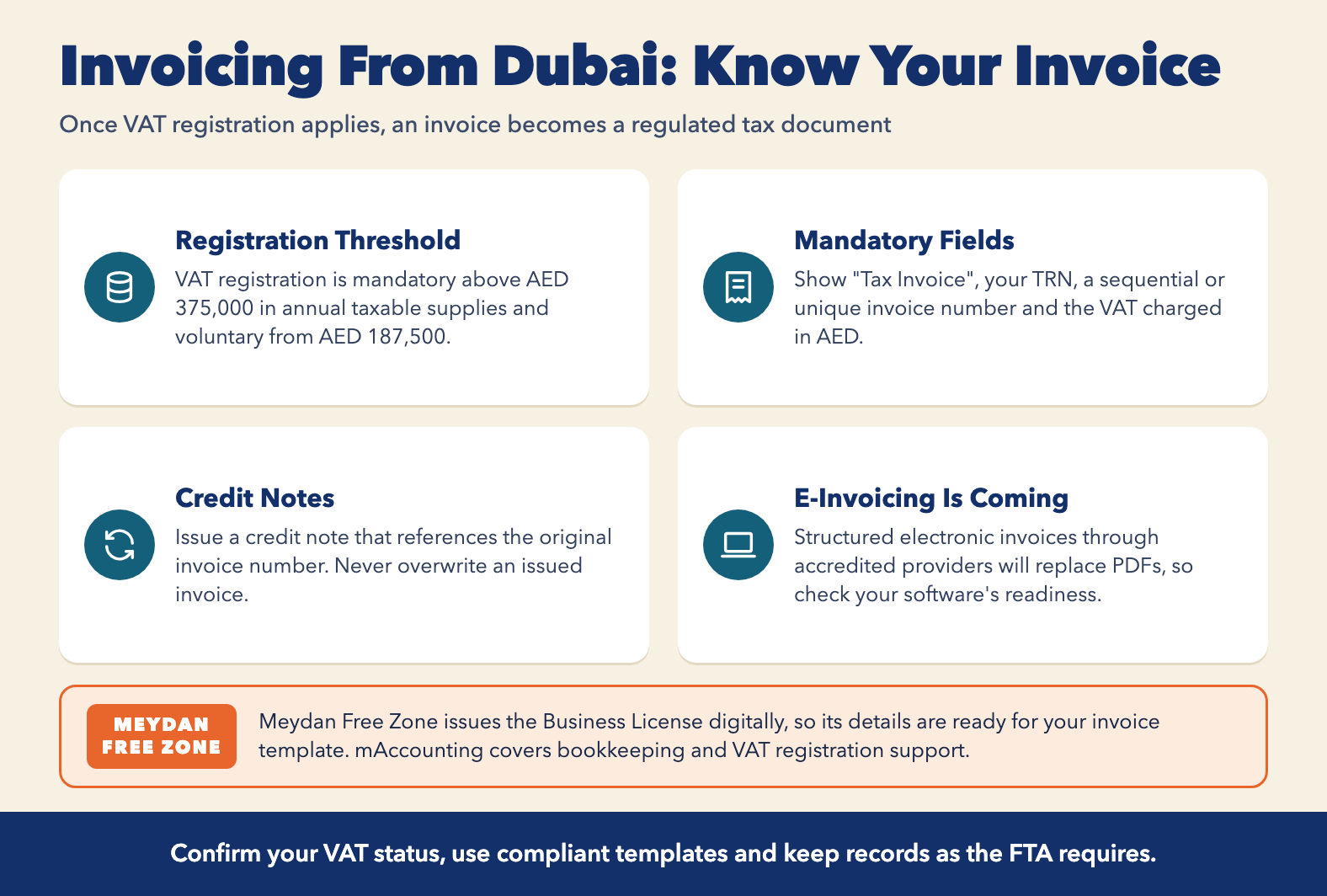
A UAE tax invoice must show the words "Tax Invoice" and the supplier's name, address and Tax Registration Number (TRN). It also needs a sequential or unique invoice number, the issue date, a description of the supply, the amount excluding VAT, the VAT charged in AED and the total payable. Our guide to UAE tax invoice requirements lists the full set, including recipient details in specified cases.
Mandatory Fields on Every Tax Invoice
- Supplier and customer details
- TRN and a sequential or unique invoice number
- Date of issue, and date of supply if different
- Per-line VAT and totals in AED
A design agency that omits its TRN can expect a corporate client's finance team to reject the invoice.
Simplified Tax Invoices and Credit Notes
Simplified tax invoices are allowed only in cases set out in the VAT Executive Regulation, and those rules are changing as e-invoicing arrives, so check the FTA's current guidance. Credit notes correct errors or returns. If a client returns a product, issue a credit note that references the original invoice number. Never overwrite an issued invoice.
Currency, Language and Record Retention
VAT amounts must appear in AED, even when a contract is priced in another currency. Keep records retrievable for the period the FTA sets, which is generally five years.
How VAT Affects Your Invoices
VAT requires registered businesses to charge 5% on most supplies, show it separately and report it to the FTA. Some supplies are zero-rated or exempt, and the invoice must reflect the correct treatment. Our guide to VAT in the UAE covers the wider system.
Standard, Zero-Rated and Exempt Supplies
The standard rate is 5%. Qualifying exports are zero-rated, so a Dubai trader exporting goods invoices at 0% and keeps export evidence on file. Exempt supplies differ from zero-rated ones, because exempt supplies carry no input tax recovery.
Free Zone Supplies and Designated Zones
Free zone status doesn't automatically remove VAT. Treatment depends on the goods, the location and the zone's designation. A free zone service company invoicing a mainland client usually charges VAT if registered.
Registration Timing and Your First Invoice
- Mandatory above AED 375,000 in annual taxable supplies
- Voluntary from AED 187,500
- Register within 30 days of crossing the threshold
- Issue tax invoices only once registered
Steps to Issue a Compliant Invoice in the UAE
To issue a compliant invoice, confirm your VAT status, choose the invoice type and add all mandatory fields. Then apply the right VAT treatment, number the invoice, send it and record it in your books.
Step 1: Confirm Registration Status and Invoice Type
- Check your TRN status.
- Choose a commercial or tax invoice.
- Switch templates on the registration effective date.
Step 2: Complete Fields and Apply VAT
Add every mandatory field. Apply 5%, 0% or exempt treatment line by line, with a separate VAT column and totals in AED.
Step 3: Number, Send and Record
Use a sequential or unique numbering system so each invoice can be identified. Send invoices with payment terms and bank details. Record each one in the ledger the same month, then reconcile invoices against bank receipts every month.
E-Invoicing Changes for Dubai Companies
The UAE is introducing mandatory e-invoicing through the Ministry of Finance, moving businesses from PDF invoices to structured electronic formats exchanged through accredited service providers. Rollout is phased, and the e-invoicing in the UAE overview explains how it applies by business size.
What Changes From PDF to Structured Data
Structured formats replace manual PDFs. Accredited providers transmit invoice details, so your accounting software must be compatible. A small trading company running spreadsheet invoices should move to e-invoice-ready software early.
Preparing Your Accounting System
- Clean customer and TRN records
- Use consistent item descriptions
- Ask your software vendor about readiness
Payment Terms and Late Payment Risk
Payment terms in the UAE are set by contract, not statute, for most B2B sales. State the due date, payment methods, bank details and late-payment consequences on every invoice. Clear terms reduce disputes.
Setting Terms That Hold Up
Agree Net 15, 30 or 60 days in writing and reference the contract on the invoice. A consultancy might take 50% upfront from a first-time client.
Bank Details and Payment Methods
- Use the company account, not a personal one
- Include IBAN and SWIFT for international clients
- Match the invoiced name to the account holder
When Unpaid Invoices Become Disputes
Send written reminders and keep proof of delivery. A formal reminder after 30 days overdue is reasonable. Seek legal advice if a dispute escalates.
Setup for a Meydan Free Zone Company
A Meydan Free Zone company should set up a bank account, an accounting routine and an invoice template before the first sale. Meydan Plus includes mCore for business bank account support and mAccounting for bookkeeping, VAT registration support and Corporate Tax support. VAT is a federal tax administered by the FTA, so the same registration thresholds apply to a free zone company.
Bank Account and Company Documents
After registration, Meydan Free Zone issues the Business License and Certificate of Formation digitally. Use the license details on your invoices. Through Fawri, a single-shareholder company can receive its Business License in under 60 minutes, so a solo founder can prepare templates the same day.
Bookkeeping and VAT Support
Match invoices to ledger entries every month, or use mAccounting's bookkeeping and VAT registration support if you'd rather not do this in-house. Bank account approval rests with the bank, so plan for onboarding checks before your first client payment.
Free Business Setup Cost Calculator
Calculate NowConclusion
Invoicing is an operational discipline, not an afterthought. Confirm your VAT status, use compliant templates and keep records current. Build the process before the first client pays, then review it each quarter as your VAT status and e-invoicing obligations change. For a Meydan Free Zone company, the Business License is issued digitally, so the license details your invoice template needs are ready from day one.
Ready to Launch Your Business in Dubai?
Let's Connect