Table of Contents
Frequently Asked Questions
Can a foreign company owe UAE Corporate Tax without an office in the UAE?
Yes. Under Federal Decree-Law No. 47 of 2022, a non-resident company can become taxable through a permanent establishment, UAE-sourced income, or a nexus, which for companies means income from UAE immovable property. A fixed office is not required. Staff working in the UAE, or an agent concluding contracts for the company, can be enough. The Federal Tax Authority assesses this on the facts of the activity.
Does a Dubai-based director create a permanent establishment for an overseas company?
It can. If the director works from a fixed place in the UAE, or habitually concludes contracts on the company's behalf, the activity may amount to a permanent establishment. A director who only attends occasional meetings is treated differently. The outcome depends on where decisions are made, who signs and how the work is carried out.
Do non-resident companies need to register for Corporate Tax with the Federal Tax Authority?
Yes, if the company has a permanent establishment or nexus in the UAE. Registration is completed through the Federal Tax Authority's EmaraTax portal. The company must then file a return and keep financial statements and records. A non-resident with no taxable connection to the UAE has no registration duty.
Is selling online to UAE customers enough to make a foreign business taxable?
Not by itself. Supplying goods or services to UAE customers from abroad, with no UAE staff, premises or dependent agent, does not normally create a permanent establishment. Exposure begins when the business performs activity in the UAE or holds assets there. Contracts and invoices should reflect how the work is actually delivered.
What penalty applies if a non-resident registers late for Corporate Tax?
Failure to register on time carries an administrative penalty of AED 10,000. Further penalties can apply for late filing and for inaccurate returns. Settling your position before UAE activity starts avoids this exposure.
Can a double tax treaty stop a non-resident from being taxed in the UAE?
A treaty can narrow the definition of a permanent establishment or limit the UAE's taxing rights. Relief is not automatic. The company must claim it and keep evidence, such as a tax residency certificate and records of where the activity took place. The treaty with the company's home country determines the result.
How is a non-resident taxed on UAE property income?
Income from UAE immovable property, such as rent, creates a nexus for a non-resident company under Cabinet Decision No. 56 of 2023. The 9% rate applies to taxable income above AED 375,000, with 0% on income up to that amount. The company must register with the Federal Tax Authority and file a return.
When should a founder form a free zone company instead of trading as a non-resident?
A local entity makes sense when the founder has regular UAE presence, staff or premises. A non-resident taxed through nexus receives no free zone relief. A free zone company can access 0% on qualifying income if it meets Qualifying Free Zone Person conditions. A Meydan Free Zone license is not itself a tax exemption, so the income type still decides the outcome.
Topic Summary
What Nexus Means Under UAE Corporate Tax
Nexus is the connection between a non-resident person and the UAE that gives the country the right to tax that person. Under Federal Decree-Law No. 47 of 2022, a non-resident is taxable through a permanent establishment, UAE-sourced income or a nexus. For companies, Cabinet Decision No. 56 of 2023 defines nexus as earning income from immovable property in the UAE. The 9% rate then applies to taxable income above AED 375,000, with 0% below it.
How Nexus Works Under UAE Corporate Tax
A non-resident is taxable on income attributable to a UAE permanent establishment, on UAE-sourced income outside one, and on income from a nexus such as UAE immovable property. UAE-sourced income outside a permanent establishment falls under withholding tax, currently 0%. So exposure usually comes from activity or property in the UAE, not from payments received from it.
Permanent Establishment and Other Triggers of Nexus
A permanent establishment exists where a non-resident has a fixed place of business in the UAE, or where a dependent agent habitually concludes contracts on its behalf. A building site or construction project lasting more than six months can also create one. Profits attributable to it are then taxed at 9%.
How to Assess Your Nexus Exposure in Five Steps
To assess nexus exposure, map where your people work, where contracts are concluded, where assets sit, where income arises and which treaty applies. Compare those facts to the permanent establishment and UAE-sourced income tests, document the conclusion, and register with the FTA if a taxable connection exists.
Registration, Filing and Penalty Exposure for Non-Residents
A non-resident with a permanent establishment or nexus in the UAE must register with the FTA, file a return and pay any tax due. Late registration carries an administrative penalty of AED 10,000, so settle your position before activity starts.
Non-Resident Nexus Compared With a UAE Free Zone Company
A non-resident taxed through nexus pays 9% on attributable income above AED 375,000, with no free zone relief. A free zone company can access 0% on qualifying income if it meets Qualifying Free Zone Person conditions. The choice depends on where activity takes place and what income it earns.
Practical Decisions for Founders Before Taking Action
Decide before UAE activity begins whether to operate from abroad, appoint an independent agent, or form a local entity. Each carries different tax, substance and compliance outcomes. Document the choice early, because UAE Corporate Tax exposure is judged on facts after activity starts, not on intentions.
Nexus Under UAE Corporate Tax: When Non-Residents Become Taxable
Most non-resident founders assume no UAE office means no UAE Corporate Tax. That assumption fails more often than people expect. Under Federal Decree-Law No. 47 of 2022, a foreign company can become taxable through staff, agents, premises or property here, with or without a local entity. This guide shows where that line sits, so you can check your position before you sign a UAE client or set up locally.
What Nexus Means Under UAE Corporate Tax
Nexus is the connection between a non-resident person and the UAE that gives the country the right to tax that person. Under Federal Decree-Law No. 47 of 2022, a non-resident is taxable through a permanent establishment, UAE-sourced income or a nexus. For companies, Cabinet Decision No. 56 of 2023 defines nexus as earning income from immovable property in the UAE. The 9% rate then applies to taxable income above AED 375,000, with 0% below it.
Who Counts as a Non-Resident Person
A company is generally non-resident if it is neither incorporated in the UAE nor effectively managed and controlled here. Natural persons are taxed only on business activity above AED 1 million in turnover in a calendar year. Take a UK consulting company with no UAE entity that signs a long-term service contract delivered by staff in Dubai. It is non-resident, yet it may still have a permanent establishment here.
Why Nexus Is Not the Same as Residence
Nexus is the trigger. Residence decides the scope of income taxed. A non-resident can owe tax on UAE income without being resident. Founders also confuse a home-country tax residency certificate with protection from UAE tax. An overseas trading firm with such a certificate that earns income through a UAE branch is still taxable on that branch income.
How Nexus Works Under UAE Corporate Tax
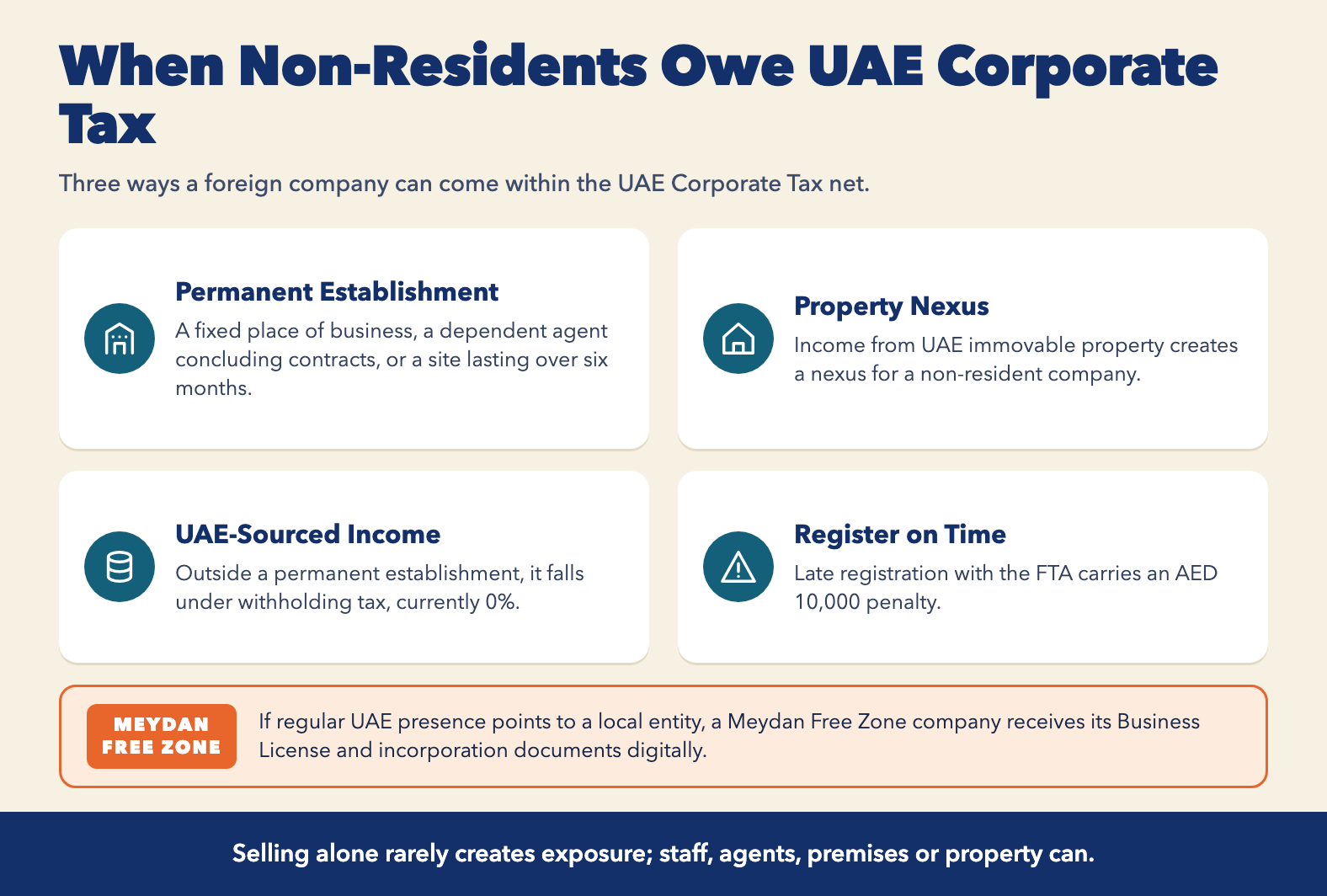
A non-resident is taxable on income attributable to a UAE permanent establishment, on UAE-sourced income outside one, and on income from a nexus such as UAE immovable property. UAE-sourced income outside a permanent establishment falls under withholding tax, currently 0%. So exposure usually comes from activity or property in the UAE, not from payments received from it.
Statutory Triggers for Non-Resident Taxation
- A permanent establishment in the UAE.
- UAE-sourced income, which currently attracts 0% withholding tax.
- A nexus: income from UAE immovable property, such as rent on a Dubai apartment.
The Ministry of Finance sets policy. The Federal Tax Authority (FTA) administers it.
Where Income Is Considered UAE-Sourced
Source follows where the activity happens and where assets sit. A European software firm invoicing UAE clients from Berlin, with no UAE staff or premises, does not create a nexus by selling alone. Where a contract is signed is not the only test. The substance of the activity decides.
Role of the Federal Tax Authority
The FTA handles registration, filing and collection. It judges nexus on facts, not on labels in a contract. A UK founder who calls a Dubai-based salesperson a "consultant" gains nothing if that person negotiates and closes deals daily.
Permanent Establishment and Other Triggers of Nexus
A permanent establishment exists where a non-resident has a fixed place of business in the UAE, or where a dependent agent habitually concludes contracts on its behalf. A building site or construction project lasting more than six months can also create one. Profits attributable to it are then taxed at 9%.
Fixed Place of Business and Dependent Agents
- An office, branch, warehouse or site used for the business counts.
- An agent with authority to conclude contracts counts.
- Independent agents acting in the ordinary course are treated differently.
Say an Asian manufacturer's Dubai-based sales manager signs distribution agreements for the company. That is a dependent agent, and a permanent establishment follows.
Preparatory and Auxiliary Activity
Storage, display or purchasing for the head office may fall outside the definition. A shipping company renting a Dubai storeroom purely for spare parts is a fair example. The exclusion fails once that activity forms a core part of the business.
Treaty Interaction
A double tax agreement can narrow the permanent establishment definition. Relief is not automatic: you must claim it and evidence it. A founder arguing that a short project creates no permanent establishment needs the treaty text and project records. See double tax treaty guide for how treaty access works.
How to Assess Your Nexus Exposure in Five Steps
To assess nexus exposure, map where your people work, where contracts are concluded, where assets sit, where income arises and which treaty applies. Compare those facts to the permanent establishment and UAE-sourced income tests, document the conclusion, and register with the FTA if a taxable connection exists.
- Map people, premises and assets. List staff, contractors, offices and equipment, including flexi-desks. A founder managing a European company from a Dubai desk is a clear example.
- Test contract authority. Identify who negotiates and signs, and where board decisions are taken.
- Trace each income stream. Separate services, goods, property and royalties. Record where each is physically performed.
- Apply treaty and threshold tests. Check the relevant agreement, then apply the AED 375,000 band to attributable income.
Document the result. Register with the FTA if a connection exists.
Registration, Filing and Penalty Exposure for Non-Residents
A non-resident with a permanent establishment or nexus in the UAE must register with the FTA, file a return and pay any tax due. Late registration carries an administrative penalty of AED 10,000, so settle your position before activity starts.
Registration and Return Filing Duties
- Register through the FTA's EmaraTax portal.
- File the annual return within nine months of the tax period end.
- Keep financial statements and records.
A foreign contractor on a 12-month UAE construction project passes the six-month test halfway through, so a permanent establishment can arise. The registration clock matters from that point.
Penalties for Late or Missed Compliance
The AED 10,000 penalty applies for failing to register on time. Further penalties apply to late filing and inaccurate returns. Read penalties for non-compliance in the UAE for the wider picture.
Support Through mAccounting
Meydan Free Zone's mAccounting offers bookkeeping, VAT registration support and Corporate Tax support for Meydan Free Zone companies. It does not replace a nexus opinion on a foreign entity.
Non-Resident Nexus Compared With a UAE Free Zone Company
A non-resident taxed through nexus pays 9% on attributable income above AED 375,000, with no free zone relief. A free zone company can access 0% on qualifying income if it meets Qualifying Free Zone Person conditions. The choice depends on where activity takes place and what income it earns.
Non-Resident Nexus Exposure Compared With a Free Zone Entity
| Feature | Non-Resident With UAE Nexus | Qualifying Free Zone Person |
|---|---|---|
| Tax rate on income | 9% on attributable income above the threshold | 0% on qualifying income, 9% on non-qualifying |
| Threshold for 0% band | 0% up to AED 375,000 | Not threshold-based; depends on income type and conditions |
| Registration requirement | Register with the FTA once a permanent establishment or nexus exists | Register with the FTA and file annually |
| Substance expectations | Judged on facts of UAE activity | Adequate substance and de minimis conditions apply |
| Treaty access | Treaty of its home country may narrow the permanent establishment | UAE treaties available to UAE tax residents with a certificate |
When a Local Entity Makes More Sense
Regular UAE presence, staff or premises point toward a local entity. Meydan Free Zone is digital-first, and issues the Business License, Certificate of Formation, Share Register and Memorandum and Articles of Association digitally. A free zone license is not a tax exemption. Qualifying status depends on the income earned, as explained in qualifying vs non-qualifying income.
Free Business Setup Cost Calculator
Calculate NowPractical Decisions for Founders Before Taking Action
Decide before UAE activity begins whether to operate from abroad, appoint an independent agent, or form a local entity. Each carries different tax, substance and compliance outcomes. Document the choice early, because UAE Corporate Tax exposure is judged on facts after activity starts, not on intentions.
Three Common Operating Models
- Remote supply with no UAE presence.
- An independent agent or distributor.
- A local entity with its own license and staff.
A trading founder who moves from invoicing UAE clients abroad to holding stock and staff in Dubai has changed model, and the tax position changes with it.
Keeping Substance and Records Aligned
Contracts, invoices and staff roles should match the stated model. Review the position after any change in activity.
Conclusion
For non-residents, UAE Corporate Tax turns on facts: where people work, who signs, where income arises and whether you hold UAE property. Map these early and you avoid surprise 9% exposure and the AED 10,000 late registration penalty. Review your current UAE activity against the permanent establishment and nexus tests. If regular UAE presence points to a local entity, a Meydan Free Zone company receives its Business License and incorporation documents digitally.
Ready to Launch Your Business in Dubai?
Let's ConnectReferences
- Federal Tax Authority (FTA), UAE, Corporate Tax guidance.