
Table of Contents
Frequently Asked Questions
What happens if a business registers for VAT late in the UAE?
The Federal Tax Authority (FTA) issues a fixed AED 10,000 penalty for late registration. Registration is mandatory when taxable supplies exceed AED 375,000 over the previous 12 months, or are expected to in the next 30 days. The penalty applies even if the business has not yet charged VAT to customers, so track rolling turnover monthly.
Is there a grace period for filing a VAT return after the deadline?
No general grace period applies. VAT returns and payments are due within 28 days after the end of each tax period. Late filing costs AED 1,000, or AED 2,000 for a repeat within 24 months, and late payment accrues at 14% a year. Paying a few days early avoids bank processing delays.
Can the Federal Tax Authority reduce or waive a VAT penalty?
Penalties are set by federal law and applied by default. A registrant can submit a reconsideration request to the FTA, but the outcome depends on the evidence provided. Correcting an error early usually costs less than waiting for the FTA to find it.
Do nil VAT returns still have to be filed?
Yes. A registered business must file a return for every tax period, even when it made no sales and owes no VAT. A dormant company that skips a nil return can receive a late filing penalty despite having no tax to pay.
How do you correct a mistake in a VAT return already submitted?
Submit a Voluntary Disclosure to the FTA with the corrected figures and supporting invoices. Acting before an audit begins generally limits exposure to the penalty for that error. Larger or repeated errors attract more scrutiny, so disclose as soon as the mistake is found.
Do free zone companies pay the same VAT penalties as mainland companies?
Yes. VAT is a federal tax administered by the FTA, so a Meydan Free Zone company follows the same registration, filing and penalty rules as any other UAE registrant. A free zone license does not remove VAT duties. Designated Zone treatment is separate and conditional.
Which invoice errors most often lead to VAT fines?
The most common errors are a missing supplier or customer Tax Registration Number, an absent 'Tax Invoice' label, a missing unique invoice number or date, and VAT not shown in AED. Failing to issue a tax invoice or credit note when required also triggers penalties. A monthly check against the mandatory fields catches most of these.
Topic Summary
VAT Penalties in the UAE and Who Enforces Them
VAT penalties in the UAE are administrative fines set by federal law and enforced by the FTA. They apply to late registration, late filing, late payment, incorrect returns and poor record-keeping. Because they are applied automatically, avoiding them comes down to meeting every deadline and keeping accurate records.
Registration Penalties and the Threshold
VAT registration is mandatory when taxable supplies exceed AED 375,000 over the previous 12 months, or are expected to in the next 30 days. Missing the 30-day application window triggers a fixed AED 10,000 late registration penalty. Voluntary registration is available from AED 187,500.
VAT Filing and Payment Deadlines
VAT return deadlines in the UAE fall 28 days after each tax period ends. Periods are usually quarterly, though the FTA can assign monthly ones. Late filing and late payment carry separate penalties, so one return can be fined twice.
Record-Keeping and Invoice Mistakes
Record-keeping penalties arise from invoices missing mandatory details, failure to issue tax invoices or credit notes, and not retaining records for the required period. Each one is avoidable with a monthly check.
Practical Steps to Avoid VAT Penalties in the UAE
To avoid VAT penalties, track rolling turnover, register within 30 days, file and pay within 28 days, issue compliant invoices and correct errors early. Here are the four steps in practice.
Correcting Errors Before the FTA Does
Voluntary Disclosure lets a registrant correct a filed VAT return by submitting a disclosure to the FTA. Acting before an audit begins generally limits exposure. Since 14 April 2026, the penalty linked to a disclosure is 1% of the tax difference for each month of delay, far less than an error found at audit.
Staying Compliant in a Free Zone
VAT is federal, so VAT penalties in the UAE apply to Meydan Free Zone companies as to any other. A free zone license does not remove VAT duties. Designated Zone treatment is separate and conditional.
VAT Penalties and How to Avoid Them: Key Rules and Deadlines
VAT penalties in the UAE rarely come from tax avoidance; they come from a missed date, a late registration or an invoice missing one required detail. Many founders assume the Federal Tax Authority (FTA) allows a grace period for small errors, but it generally doesn't.
So which mistakes cost money, and how do you prevent them? This guide sets out the main penalties, the deadlines behind them and the habits that keep a company clear of fines.
VAT Penalties in the UAE and Who Enforces Them
VAT penalties in the UAE are administrative fines set by federal law and enforced by the FTA. They apply to late registration, late filing, late payment, incorrect returns and poor record-keeping. Because they are applied automatically, avoiding them comes down to meeting every deadline and keeping accurate records.
The Federal Tax Authority's Role
The FTA administers VAT federally and issues penalty decisions. The penalties come from the VAT law (Federal Decree-Law No. 8 of 2017) and the tax procedures framework, not from the emirate or the free zone.
Say a free zone trading company assumes its authority handles VAT. It then receives an FTA penalty notice for a late return. The free zone had no role in the filing, and the fine stood.
Why Penalties Are Rarely Negotiable
Fixed fines and percentage-based charges apply by default. Reconsideration exists, but it depends on evidence, not goodwill. A founder who files one day late still gets the fine, whatever the amount due. Early correction almost always costs less than late discovery.
Registration Penalties and the Threshold
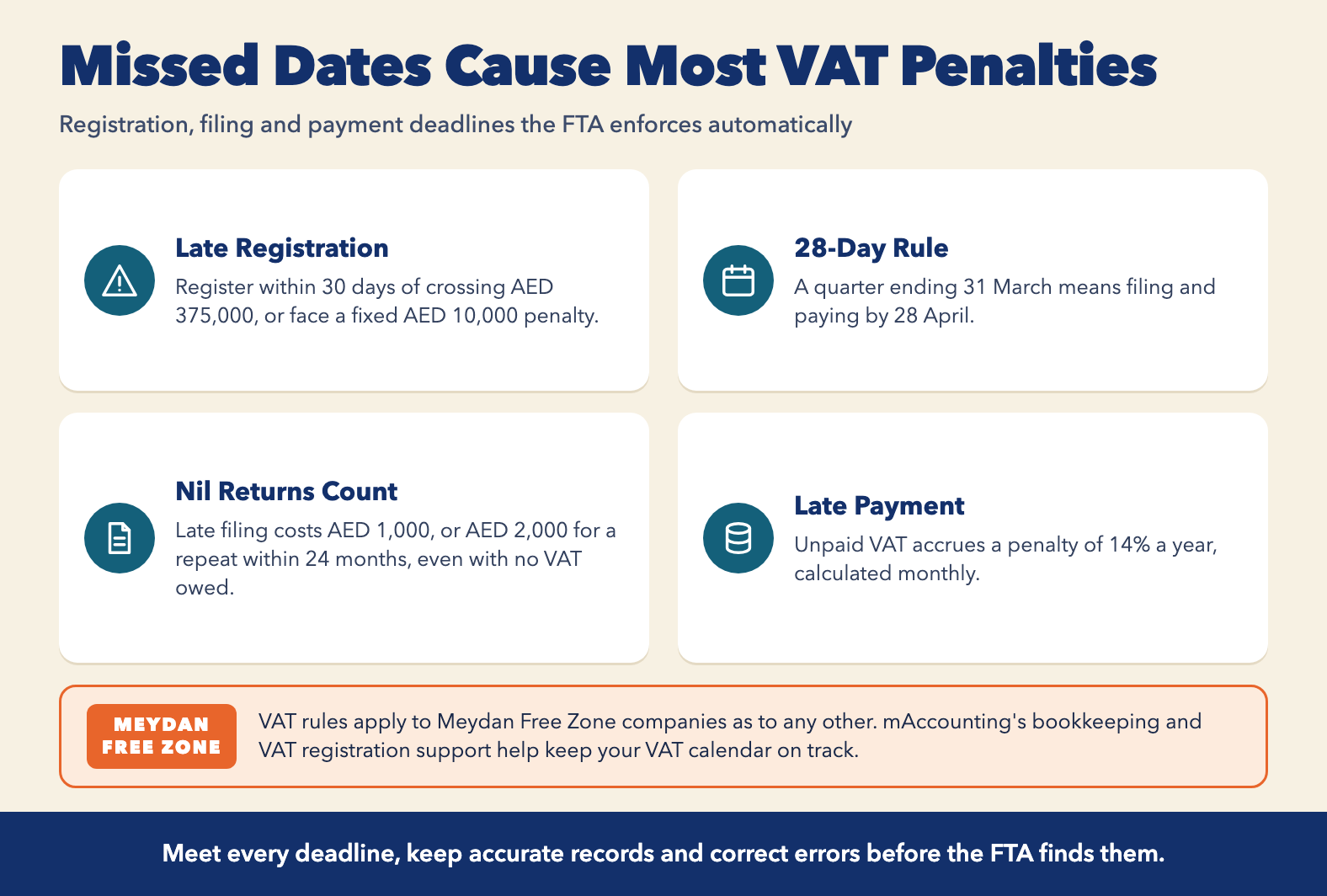
VAT registration is mandatory when taxable supplies exceed AED 375,000 over the previous 12 months, or are expected to in the next 30 days. Missing the 30-day application window triggers a fixed AED 10,000 late registration penalty. Voluntary registration is available from AED 187,500.
Mandatory and Voluntary Limits
- Mandatory threshold: AED 375,000.
- Voluntary threshold: AED 187,500.
- Turnover is measured on a rolling 12 months.
- Supplies expected under signed contracts count toward the 30-day test.
How Late Registration Happens
Founders often review turnover only at year end. A startup that does this can miss the registration window by several weeks. Contracts signed but not yet invoiced still count as expected supplies. Registration is due within 30 days of meeting the threshold.
Registering Through the FTA
Registration is made on the FTA's EmaraTax portal with your trade license, Emirates ID, passport and turnover evidence. Meydan Free Zone's mAccounting offers VAT registration support to help prepare that evidence before you apply.
VAT Filing and Payment Deadlines
VAT return deadlines in the UAE fall 28 days after each tax period ends. Periods are usually quarterly, though the FTA can assign monthly ones. Late filing and late payment carry separate penalties, so one return can be fined twice.
Return Periods and the 28-Day Rule
Check the period assigned on your FTA account. A quarter ending 31 March means filing and paying by 28 April. Payment must clear by that date, not merely be initiated.
Late Filing vs Late Payment
- Late filing costs AED 1,000, or AED 2,000 for a repeat within 24 months, even when no VAT is owed.
- Late payment accrues at 14% a year, calculated monthly, on the unpaid amount.
- Nil returns must still be filed.
A dormant company that skips a nil return receives a late filing fine despite owing nothing.
Building a Filing Calendar
Set internal deadlines one week before FTA dates. Align VAT with Corporate Tax and license renewals using a company compliance calendar. Name one owner for sign-off. A two-person company can schedule its review on day 21 of every filing window.
Record-Keeping and Invoice Mistakes
Record-keeping penalties arise from invoices missing mandatory details, failure to issue tax invoices or credit notes, and not retaining records for the required period. Each one is avoidable with a monthly check.
Mandatory Tax Invoice Details
- The words "Tax Invoice" clearly displayed.
- Supplier and customer names, addresses and TRN.
- Unique number and issue date.
- Itemised supply with VAT shown in AED.
An invoice issued without the customer's Tax Registration Number (TRN) can be challenged in an FTA review. See the full UAE tax invoice requirements.
Common VAT Penalty Triggers and Preventive Action
| Feature | Trigger | Preventive Action |
|---|---|---|
| Late registration | Turnover passes AED 375,000 and no one notices within 30 days | Update a rolling 12-month turnover sheet monthly |
| Late return filing | Return, including a nil return, not filed within 28 days | Review on day 21 with one named owner |
| Late payment | Funds not cleared by the 28-day deadline | Pay several days early to allow for bank processing |
| Incorrect return | Ledger totals do not match the filed figures | Reconcile sales and purchase ledgers before filing |
| Missing or incomplete tax invoice | Invoice lacks the customer's TRN or the "Tax Invoice" label | Run a monthly check against mandatory fields |
Retention and Audit Readiness
Records generally must be kept for five years, in Arabic or English, in a form you can retrieve. Picture an FTA audit requesting invoices from two years earlier and the business unable to find them. Reconcile ledgers to filed returns every period.
Practical Steps to Avoid VAT Penalties in the UAE
To avoid VAT penalties, track rolling turnover, register within 30 days, file and pay within 28 days, issue compliant invoices and correct errors early. Here are the four steps in practice.
Step 1: Monitor Rolling Turnover
Update a 12-month sheet monthly. Add signed contracts to the 30-day forecast. A trading firm that flags a pending contract before it lands avoids a late registration.
Step 2: Register and Confirm Your Tax Period
Register inside the window. Then check your FTA account for the assigned period and first return date.
Step 3: Reconcile, File and Pay Early
Reconcile ledgers first. Pay by day 24, not day 28, so bank processing never causes a late payment.
Step 4: Review Invoices and Correct Errors Fast
Check invoices monthly. A finance lead who spots an under-declared sale should disclose it before any FTA contact. For more on filing support, see VAT filing services in Dubai.
Correcting Errors Before the FTA Does
Voluntary Disclosure lets a registrant correct a filed VAT return by submitting a disclosure to the FTA. Acting before an audit begins generally limits exposure. Since 14 April 2026, the penalty linked to a disclosure is 1% of the tax difference for each month of delay, far less than an error found at audit.
When Voluntary Disclosure Applies
It covers errors in a previously filed return, such as a misclassified zero-rated supply found after filing. Treatment varies with amount and timing, so confirm current thresholds on the FTA site.
What to Prepare Before Disclosing
- Corrected figures with supporting invoices.
- A short explanation of the cause.
- A reconciliation showing how the error arose.
- One internal control change to prevent repeats.
Staying Compliant in a Free Zone
VAT is federal, so VAT penalties in the UAE apply to Meydan Free Zone companies as to any other. A free zone license does not remove VAT duties. Designated Zone treatment is separate and conditional.
A free zone e-commerce seller that assumes it is exempt will register late and pay for it. Meydan Free Zone's mAccounting covers bookkeeping, VAT registration support and Corporate Tax support. A company keeping monthly books can prepare its quarterly return in one review.
Free Business Setup Cost Calculator
Calculate NowConclusion
Avoiding VAT penalties is about execution. Track rolling turnover, register inside 30 days, file and pay within 28 days, issue compliant invoices and correct errors early. Penalties follow rules, not intent.
Build a VAT calendar now, assign one owner and review your records before the next return is due. A Meydan Free Zone company follows the same FTA rules, and mAccounting's bookkeeping and VAT registration support can help keep that calendar on track.
Ready to Launch Your Business in Dubai?
Let's ConnectReferences
- Federal Tax Authority (FTA), UAE: VAT guidance, penalties, registration and Voluntary Disclosure, including Federal Decree-Law No. 8 of 2017 on VAT.