
Table of Contents
Frequently Asked Questions
Is a purchase order legally binding in the UAE once the supplier accepts it?
In most cases, yes. Under UAE civil law principles, an offer and its acceptance can form a contract, so an accepted purchase order may be treated as binding. The price, quantity and delivery terms in the accepted order are the first reference point in a dispute. Written acceptance strengthens the position, and legal advice helps where terms are contested.
Can a purchase order replace a tax invoice for VAT purposes?
No. A purchase order is a buyer's order document and has no prescribed tax format. VAT input tax recovery depends on a valid tax invoice from the supplier that meets Federal Tax Authority requirements. The purchase order number on the invoice helps match the two documents.
Who should sign a purchase order in a small company?
An authorised signatory named by the company should sign it, usually the owner or a manager with defined approval limits. Where a representative signs for the owner, a power of attorney should confirm that authority. Separating the person who requests an order from the person who approves it reduces the risk of unauthorised spending.
What details should appear on a purchase order issued by a UAE company?
It should carry a unique PO number, the legal entity name, license number and address, and the supplier's details. It should also state the item description, quantity, agreed price in AED, delivery terms and payment terms. Add the Tax Registration Number if the company is VAT-registered, along with the signatory's name and the company stamp where used.
Do free zone companies need purchase orders to deal with suppliers?
No law requires a purchase order for every transaction, but suppliers, banks and auditors expect a document trail. A Meydan Free Zone company should show its Business License details on each order. Keeping orders, delivery notes and invoices together makes bookkeeping, VAT and Corporate Tax records easier to reconcile, whether in-house or through mAccounting.
What should a buyer do if the invoice does not match the purchase order?
Hold the payment and compare the invoice with the purchase order and the signed delivery note. Notify the supplier in writing of the difference in price or quantity and request a corrected invoice. Pay only once the three documents agree.
Can a purchase order be amended after the supplier accepts it?
Yes, but only by mutual agreement. Record any change in a revised purchase order that references the original number, and obtain written acceptance from the supplier again. Verbal or WhatsApp changes without a revised document often lead to disputes over price and scope.
Topic Summary
What a Purchase Order Is and Why It Matters
A purchase order (PO) is a written document a buyer issues to a supplier to confirm goods or services, quantities, prices and delivery terms. Once the supplier accepts it, it serves as evidence of what both sides agreed. It supports later invoicing, payment and dispute resolution.
Purchase Order, Invoice and Quotation: The Differences
A quotation is the supplier's price offer. A purchase order is the buyer's confirmed order. An invoice is the supplier's payment request after supply. A tax invoice must also meet Federal Tax Authority (FTA) requirements.
Seven Stages of the Purchase Order Process
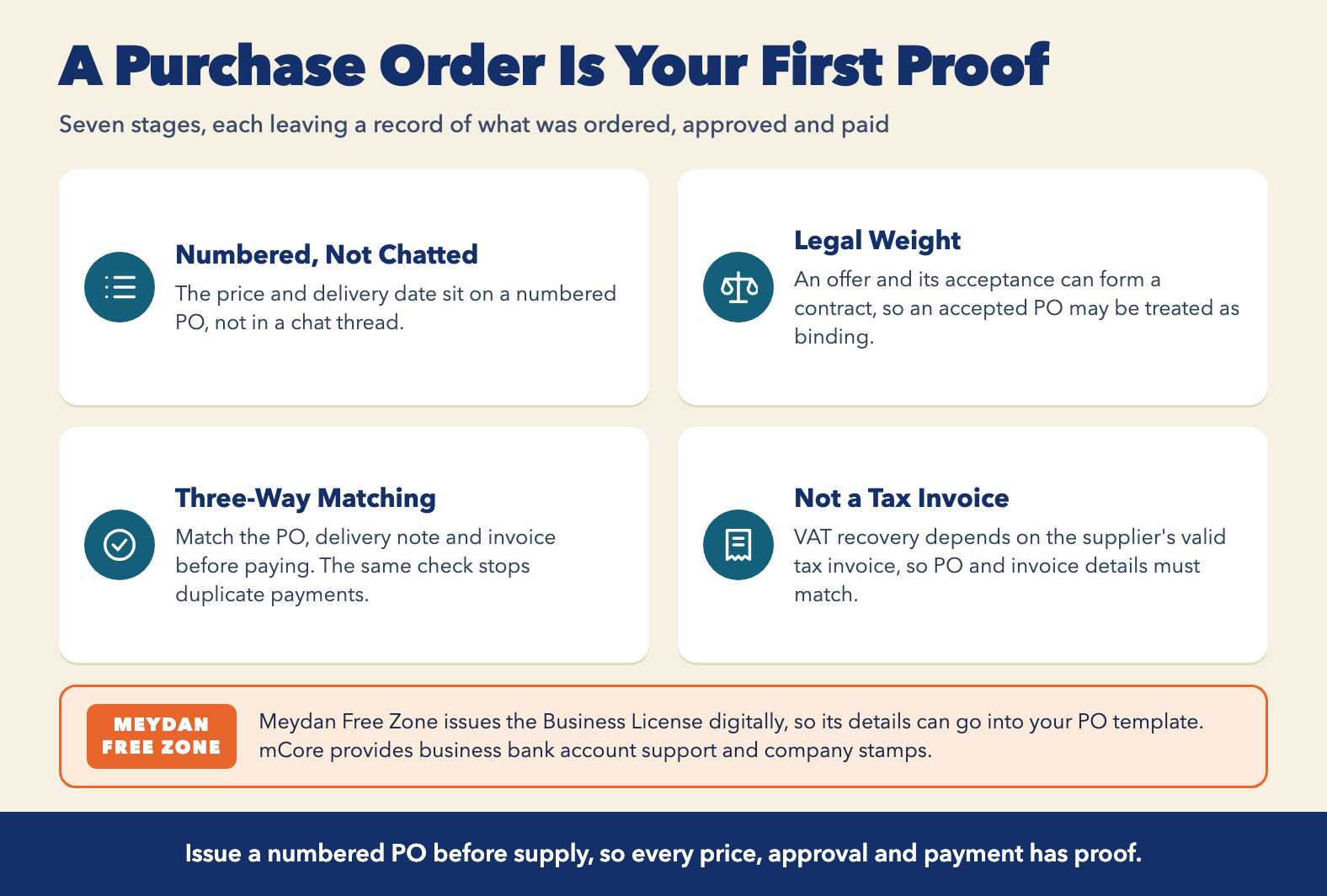
The process runs through seven stages: request, quotation, approval, issue, confirmation, receipt and matching, then payment. Each stage should leave a record, so you can prove what was ordered, approved and paid.
What a New Business Needs Before Issuing Purchase Orders
No UAE law sets a standard purchase order format, so the essentials are practical: a valid trade license, the company's registered name, a business bank account and a consistent PO template. Suppliers commonly ask for license details and, where applicable, a Tax Registration Number (TRN).
How Purchase Orders Support Tax Records
A purchase order is not a tax document. It supports VAT input tax claims and Corporate Tax records by showing what was agreed. VAT recovery depends on a valid tax invoice, so PO and invoice details must match.
Cost, Payment and Risk Controls for Purchase Orders
Purchase orders control cost by fixing price, quantity and payment terms before supply. Pay through the business bank account and reference the PO number in the transfer.
What a Purchase Order Means for a Meydan Free Zone Company
Meydan Free Zone issues the Business License digitally, and those license details belong on every purchase order you issue.
Purchase Order Process for UAE Businesses: Key Points for New Businesses
A purchase order can look like internal paperwork, yet it is often the first document a supplier, a bank or an auditor asks to see. Many new founders approve orders by email or WhatsApp, and the gap shows when a delivery is disputed or a payment is questioned. This guide explains how a purchase order works, how the process runs from request to payment and what to set up before your first order.
What a Purchase Order Is and Why It Matters
A purchase order (PO) is a written document a buyer issues to a supplier to confirm goods or services, quantities, prices and delivery terms. Once the supplier accepts it, it serves as evidence of what both sides agreed. It supports later invoicing, payment and dispute resolution.
What a Purchase Order Records
It names the buyer and supplier, with trade license details. It lists the item, quantity, agreed price in AED, delivery terms and payment terms, under a unique PO number. Say a Dubai trading start-up orders 200 units. The price and delivery date sit on a numbered PO, not in a chat thread.
Why Founders Underestimate It
Email approvals carry no reference number and often no named approver. Verbal changes create disputes over price and scope. A supplier delivers a revised quantity after a WhatsApp message, and the buyer then disputes the invoice. Banks and auditors expect a document trail.
Legal Weight Under UAE Civil Law
Under UAE civil law principles, an offer and its acceptance can form a contract, so an accepted PO may be treated as binding. A late delivery claim would usually rely on the delivery date in that PO. State liability and delivery terms clearly, and take legal advice if the terms are disputed.
Purchase Order, Invoice and Quotation: The Differences
A quotation is the supplier's price offer. A purchase order is the buyer's confirmed order. An invoice is the supplier's payment request after supply. A tax invoice must also meet Federal Tax Authority (FTA) requirements.
Who Issues Each Document and When
For office equipment, the supplier sends the quote first. You issue the PO after approval. The supplier invoices after delivery or as agreed.
How a Purchase Order Supports Three-Way Matching
Match the PO, delivery note and invoice before paying. Say an invoice charges for 120 units while the delivery note shows 100. You catch the mismatch before payment. The same check stops duplicate payments.
Where Tax Invoice Rules Apply
A PO is not a tax invoice. A VAT-registered supplier issues a tax invoice, often quoting your PO number. Our guide to UAE tax invoice requirements explains the mandatory details, which are set by the Federal Tax Authority.
Purchase Order and Tax Invoice Compared
| Feature | Purchase Order | Tax Invoice |
|---|---|---|
| Issued by | The buyer | The supplier |
| Timing | After internal approval, before supply | After delivery, or as agreed |
| Purpose | Confirms what is ordered, at what price | Requests payment and supports VAT recovery |
| Tax format prescribed | No prescribed tax format | Mandatory details set by the Federal Tax Authority |
| Use in disputes | First evidence of agreed terms | Evidence of the amount claimed |
Seven Stages of the Purchase Order Process
The process runs through seven stages: request, quotation, approval, issue, confirmation, receipt and matching, then payment. Each stage should leave a record, so you can prove what was ordered, approved and paid.
Stages 1 to 3: Request, Quote and Approve
- Requisition states the need and budget.
- Compare at least two quotations where practical.
- Set approval limits, even for a small team.
- Example: orders above a set AED amount need a second sign-off.
Stages 4 and 5: Issue and Confirm
- Issue a numbered PO with full terms.
- Obtain written supplier acceptance before production begins.
- Record amendments as revised POs.
Stages 6 and 7: Receive, Match and Pay
- Inspect goods and sign the delivery note.
- Match against the PO and invoice.
- Release payment only when all three agree.
- Pay from the business bank account and file the records.
What a New Business Needs Before Issuing Purchase Orders
No UAE law sets a standard purchase order format, so the essentials are practical: a valid trade license, the company's registered name, a business bank account and a consistent PO template. Suppliers commonly ask for license details and, where applicable, a Tax Registration Number (TRN).
Details Every Purchase Order Should Carry
- Legal entity name, license number and address.
- TRN where registered.
- Authorised signatory name and company stamp where used.
Prepare the template with fixed header fields before the first order.
Authorised Signatories and Company Stamp
Define who can sign. A manager signing under a power of attorney from the owner needs that document on file. Decide too whether your company stamp goes on every PO.
Record Keeping Expectations
Keep each PO with its invoice and delivery note in one folder. These records support VAT and Corporate Tax filings.
How Purchase Orders Support Tax Records
A purchase order is not a tax document. It supports VAT input tax claims and Corporate Tax records by showing what was agreed. VAT recovery depends on a valid tax invoice, so PO and invoice details must match.
VAT Input Tax and Matching Documents
Under FTA rules, VAT registration is mandatory above AED 375,000 in annual taxable supplies. A PO number on the invoice speeds up reconciliation. A VAT-registered buyer should ask for a corrected invoice if the supplier's TRN is missing.
Corporate Tax Evidence for Expenses
Expenses need supporting documents. When an auditor asks about a large equipment purchase, the PO, delivery note and invoice form your trail. Poor records can lead to penalties for non-compliance.
Cost, Payment and Risk Controls for Purchase Orders
Purchase orders control cost by fixing price, quantity and payment terms before supply. Pay through the business bank account and reference the PO number in the transfer.
Approval Limits and Budget Control
- Set limits by amount.
- Separate the requester from the approver.
- Review open POs every month.
Supplier Due Diligence
Verify the supplier's trade license and TRN. Confirm bank details by phone. A buyer who calls back can detect altered bank details in an emailed invoice. Avoid advance payment without protections.
When Disputes Escalate
The accepted PO is your first evidence. Keep written acceptance and every amendment. A short delivery dispute can often be settled by pointing to the agreed quantity.
What a Purchase Order Means for a Meydan Free Zone Company
Meydan Free Zone issues the Business License digitally, and those license details belong on every purchase order you issue.
License Details and Banking Set Up
Through Meydan Plus, mCore provides business bank account support and company stamps. Account approval rests with the bank. Once the license and stamp are issued, prepare your PO template.
Bookkeeping and Tax Records
mAccounting covers bookkeeping, VAT registration support and Corporate Tax support. Organised POs make reconciliation against supplier invoices simpler. Meydan Free Zone's Cost Calculator helps you estimate setup costs.
Free Business Setup Cost Calculator
Calculate NowConclusion
A purchase order works when it is issued before supply, approved by the right person and kept with the delivery note and tax invoice. Execution matters more than templates. With Meydan Free Zone, the Business License is issued digitally, so its details can go into your PO template before the first order.
Ready to Launch Your Business in Dubai?
Let's Connect