Table of Contents
Frequently Asked Questions
Can a UAE company pay Corporate Tax on gains it has not yet received?
Yes. Under the default accounting treatment, fair value movements on assets such as listed shares or crypto flow into accounting income and can become taxable income without any cash being received. A taxable person who qualifies and elects the realisation basis recognises eligible gains only when the asset is sold or the liability is settled.
Who decides whether an asset counts as held on capital account?
The business makes the first classification when it prepares its books, based on why it holds the asset. Long-term investments and property held for the long term are typically capital account items, while trading stock is not. The Federal Tax Authority administers Corporate Tax and can challenge a classification that does not match the records.
Does the election change the 0% rate on the first AED 375,000 of taxable income?
No. The election changes when a gain or loss is recognised, not the rate. Taxable income up to AED 375,000 is still taxed at 0% and the excess at 9%. Because deferred gains can land in one year after a large sale, that disposal may push taxable income above the threshold.
Can a business switch back to taxing fair value movements every year?
Not freely. The election is irrevocable except in exceptional circumstances approved by the Federal Tax Authority. A founder should confirm the current conditions with the authority before seeking any change.
Is the election available to businesses using the cash basis?
The election is relevant to businesses that prepare financial statements on an accrual basis. Cash basis is a separate option for smaller businesses under the revenue limit of AED 3 million set by the Ministry of Finance. The two address different problems, so a business generally chooses the one that fits its reporting basis.
Are unrealised losses relieved under the realisation basis?
No. The treatment works in both directions. Unrealised gains are deferred until realisation, and unrealised losses are also deferred until the asset is sold or the liability is settled. A founder should weigh that before electing in a year when values are falling.
Do Meydan Free Zone companies make this election with the free zone or the Federal Tax Authority?
With the Federal Tax Authority. Meydan Free Zone companies are taxable persons under the federal Corporate Tax Law, so the election is recorded in the return filed through EmaraTax. Meydan Free Zone issues the Business License and incorporation documents digitally, and its mAccounting pillar supports bookkeeping and Corporate Tax work.
Topic Summary
What Is a Realisation Basis Election Under UAE Corporate Tax
A realisation basis election lets a taxable person count gains and losses on eligible items only when they are realised, such as on sale or settlement, not on yearly revaluation. It sits in Article 20 of Federal Decree-Law No. 47 of 2022 and is open only to businesses that prepare financial statements on an accrual basis.
Which Assets and Liabilities Qualify for the Election
The election comes in two forms. It can cover all assets and liabilities subject to fair value or impairment accounting, or only those held on capital account, such as long-term investments and investment property. Under the capital-account option, revenue account items such as trading stock stay on the normal basis. The business must also report on an accrual basis.
How to Make the Realisation Basis Election
To make the election, confirm accrual reporting and choose which items it covers. Decide during your first tax period, record it in your first return on the FTA's EmaraTax portal, and apply it consistently. Keep supporting schedules for each item.
Cost, Cash Flow and Compliance Risks
The election defers tax on unrealised gains until sale or settlement, which helps cash flow in rising markets. It defers loss relief too. Poor classification, inconsistent application or missing workings can lead to adjusted returns and FTA penalties.
Realisation Basis Versus Accrual Treatment of Unrealised Gains
Under default accrual treatment, fair value movements flow into taxable income yearly. Under the realisation basis election, eligible gains and losses count only when realised. The first brings earlier tax and relief; the second brings later tax and steadier cash alignment.
How Meydan Free Zone Companies Handle the Election
Meydan Free Zone companies are taxable persons under the federal law, so the realisation basis election is made with the FTA, not the free zone. The mAccounting pillar offers bookkeeping and Corporate Tax support, which helps keep classification and workings in order.
Conclusion
The realisation basis election is a timing decision, not a tax saving. It suits founders holding long-term capital assets who want tax to follow actual disposals. Decide before the first return, classify assets properly and keep records for every item.
Realisation Basis Election Under UAE Corporate Tax
If your company holds investments, property or crypto, the first Corporate Tax return raises an awkward question: will paper gains be taxed before a dirham arrives? Some founders assume yes, others assume unrealised movements never matter, and both views can distort a tax bill in a volatile year. The realisation basis election decides when those gains and losses count. This guide explains how it works, who can use it and what to settle before your first return.
What Is a Realisation Basis Election Under UAE Corporate Tax
A realisation basis election lets a taxable person count gains and losses on eligible items only when they are realised, such as on sale or settlement, not on yearly revaluation. It sits in Article 20 of Federal Decree-Law No. 47 of 2022 and is open only to businesses that prepare financial statements on an accrual basis.
Realised and Unrealised Gains Explained
Realised means a sale, disposal or settlement has happened. Unrealised means value moved on the balance sheet only. Taxable income starts from accounting income under accepted standards, so fair value movements can create tax without cash.
Take a Dubai trading company holding listed shares that rise at year-end but aren't sold. By default, that uplift enters accounting profit. Taxable income above AED 375,000 is charged at 9%.
Where the Election Sits in the Corporate Tax Law
The election is a statutory option, not an automatic treatment. It links to the rules on accounting basis and on unrealised gains and losses. The Federal Tax Authority (FTA) administers Corporate Tax and receives the return. For wider context, see UAE corporate tax explained.
Which Assets and Liabilities Qualify for the Election
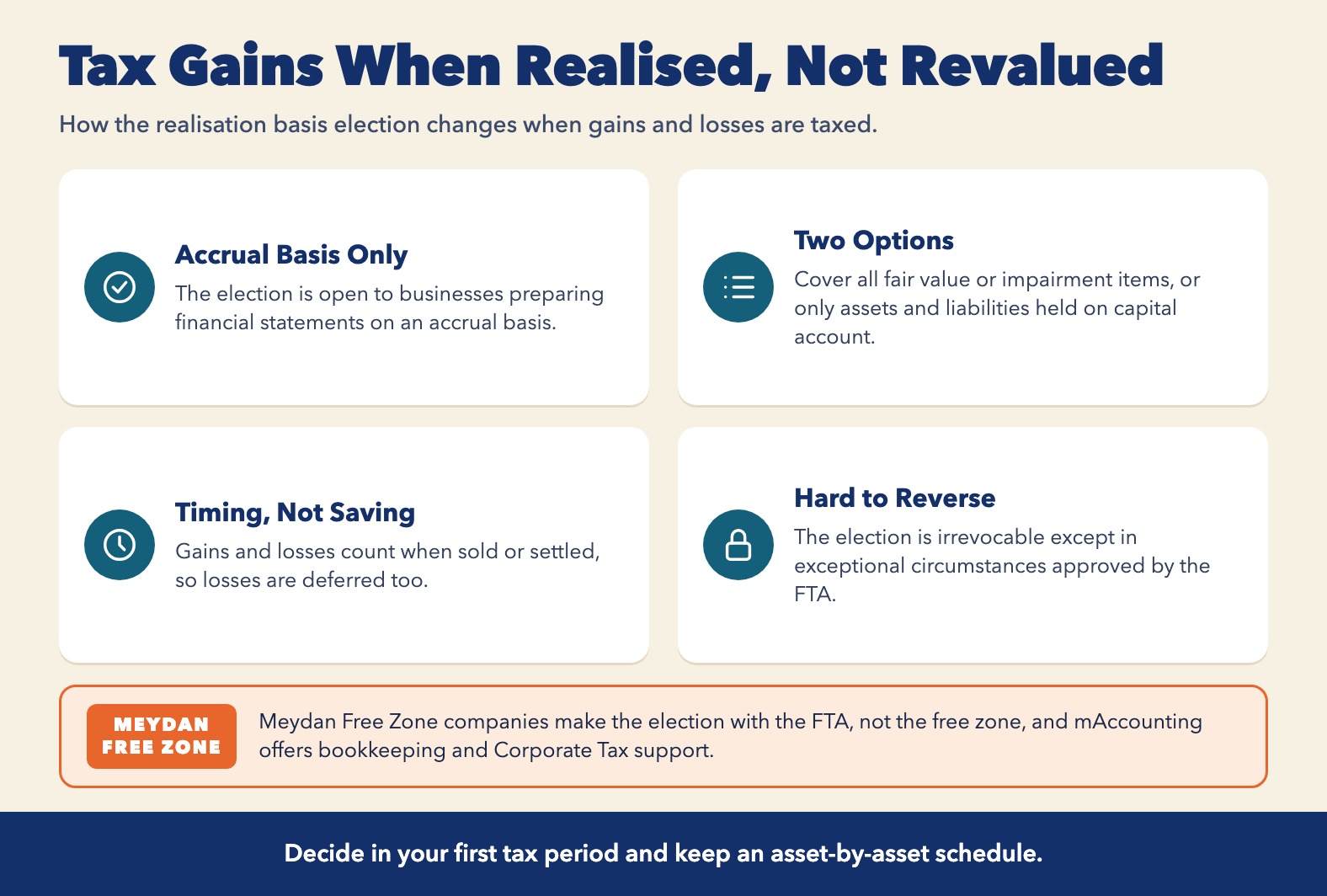
The election comes in two forms. It can cover all assets and liabilities subject to fair value or impairment accounting, or only those held on capital account, such as long-term investments and investment property. Under the capital-account option, revenue account items such as trading stock stay on the normal basis. The business must also report on an accrual basis.
Capital Account Versus Revenue Account Items
- Capital items are held long term, not for resale.
- Under the capital-account option, revenue items stay under normal accounting treatment.
- Classification must match your books.
Under the capital-account option, a holding company's long-term stake in a logistics firm is covered. Its sister trading entity's inventory is not.
Accrual Basis Requirement and the Cash Basis Alternative
Businesses with revenue of AED 3 million or less may use the cash basis under Ministerial Decision No. 114 of 2023. Cash basis and the election solve different problems. One changes when income is counted; the other changes when capital movements are counted.
How to Make the Realisation Basis Election
To make the election, confirm accrual reporting and choose which items it covers. Decide during your first tax period, record it in your first return on the FTA's EmaraTax portal, and apply it consistently. Keep supporting schedules for each item.
Step 1: Confirm Your Accounting Basis
- Check statements follow accepted standards on accrual.
- Confirm your year-end and first tax period.
Step 2: Identify Eligible Items
- Separate capital items from trading items.
- Record opening values and fair value movements.
Step 3: Record the Election in the Return
- File through EmaraTax.
- The return is due nine months after the period ends.
- Keep workings reconciling accounting profit to taxable income.
Step 4: Apply It Consistently
- Cover eligible items consistently, not selectively by year.
- The election is irrevocable except in exceptional circumstances approved by the FTA.
Support for this process is available through corporate tax services in Dubai.
Cost, Cash Flow and Compliance Risks
The election defers tax on unrealised gains until sale or settlement, which helps cash flow in rising markets. It defers loss relief too. Poor classification, inconsistent application or missing workings can lead to adjusted returns and FTA penalties.
Timing Benefit and Timing Cost
Say a founder's company sells a long-held investment after five years. Several years of gains land in one return, and the profit can sit well above the AED 375,000 band taxed at 0%. Plan disposals with that in mind.
Realisation Basis Versus Default Accrual Treatment
| Feature | Realisation Basis Election | Default Accrual Treatment |
|---|---|---|
| When gains are taxed | In the year of sale or settlement | Each year, as fair value moves |
| When losses are relieved | Only after the loss is realised | In the year the value falls |
| Cash flow alignment | Tax follows cash from disposals | Tax can fall due with no cash received |
| Items covered | Fair value or impairment items, or capital account items only, depending on the option chosen | All items in accounting income |
| Record-keeping requirement | Asset-by-asset schedules tracking unrealised movements | Standard accounting records |
Record-Keeping and Penalty Exposure
- Keep records for seven years after the end of each tax period.
- Maintain asset-by-asset schedules.
- Incorrect returns and late filing attract penalties under FTA published rules.
Realisation Basis Versus Accrual Treatment of Unrealised Gains
Under default accrual treatment, fair value movements flow into taxable income yearly. Under the realisation basis election, eligible gains and losses count only when realised. The first brings earlier tax and relief; the second brings later tax and steadier cash alignment.
Side-by-Side Comparison
Take an investment that gains AED 400,000 in year one and is sold in year three. Default treatment taxes the gain in year one. The election taxes it in year three.
Interaction With Exemptions and Qualifying Income
The election doesn't change whether income is exempt or qualifying. Qualifying Free Zone Person status is assessed separately; see qualifying vs non-qualifying income. Small Business Relief has its own election and revenue limit.
How Meydan Free Zone Companies Handle the Election
Meydan Free Zone companies are taxable persons under the federal law, so the realisation basis election is made with the FTA, not the free zone. The mAccounting pillar offers bookkeeping and Corporate Tax support, which helps keep classification and workings in order.
Federal Tax Authority Filing Versus Free Zone Role
Meydan Free Zone issues the Business License, Certificate of Formation, Share Register, and Memorandum and Articles of Association digitally. Fawri, for single-shareholder companies, issues a Business License in under 60 minutes. Free zone status doesn't remove the need to classify assets correctly. A solo founder holding a long-term investment still needs a clean asset schedule before the first return.
Bookkeeping and Corporate Tax Support Through mAccounting
mAccounting, part of Meydan Plus, offers bookkeeping, VAT registration support and Corporate Tax support. Clean books make the election easier to support.
Free Business Setup Cost Calculator
Calculate NowConclusion
The realisation basis election is a timing decision, not a tax saving. It suits founders holding long-term capital assets who want tax to follow actual disposals. Decide before the first return, classify assets properly and keep records for every item.
List your capital account assets and liabilities, compare tax timing under both treatments, and settle your accounting set-up before your first return. For a Meydan Free Zone company, the election is made with the FTA, so the asset schedule is the part to get right early.
Ready to Launch Your Business in Dubai?
Let's ConnectReferences
- Federal Tax Authority (FTA), UAE, Corporate Tax guidance