Table of Contents
Frequently Asked Questions
1. What license does a UK cybersecurity firm setup in the UAE need?
A professional services or technology consultancy license covers advisory, penetration testing, managed services consulting, and data protection work. No sector-specific cybersecurity regulatory license is required for these activities.
2. Is a free zone entity suitable for UK cybersecurity firm setup in the UAE?
Yes, for advisory, consultancy, and private sector managed services. If the firm intends to bid on UAE government contracts, a mainland DET-licensed entity may be required by the procurement process.
3. What is driving demand for cybersecurity services in the UAE?
Mandatory compliance with NESA Information Assurance Standards, Federal Decree-Law No. 45 of 2021 on Personal Data Protection, sector-specific regulatory frameworks, and the UAE National Cybersecurity Strategy 2025-2031. Ransomware attacks affected 73% of UAE organisations between 2021 and 2023, adding threat-driven spending on top of regulatory compliance.
4. What corporate tax applies to a UK cybersecurity firm setup in the UAE?
A free zone entity qualifying as a QFZP pays 0% corporate tax on qualifying income. The 9% rate applies above AED 375,000 on non-qualifying income. UK corporation tax may still apply if HMRC determines the entity is centrally managed from the UK.
5. Do UK cybersecurity certifications like CREST, CHECK, or ISO 27001 carry weight in the UAE?
Yes. UK certifications are recognised in the UAE market, particularly for financial services, healthcare, and multinational clients.
6. What is the difference between a free zone and mainland setup for a cybersecurity firm?
A free zone entity is suited to advisory, consulting, and private sector engagements with 100% foreign ownership and a fully digital setup. A mainland entity is needed for direct participation in UAE government procurement or for certain regulated activity categories. Most British firms start with a free zone structure.
7. How long does a UK cybersecurity firm setup in the UAE take?
A Fawri license issues digitally in under 60 minutes. The Regular license route completes within one working day.
Topic Summary
1. Rapid Digital Transformation in the UAE
The UAE's aggressive digitalization agenda, exemplified by initiatives such as Smart Dubai and the UAE National Innovation Strategy, fuels strong demand for advanced cybersecurity solutions, creating a substantial market opportunity for UK firms with proven expertise.
2. Growing Regulatory Focus on Cybersecurity
With the introduction of comprehensive data protection laws and cybersecurity regulations, including the UAE’s Information Assurance Standards and the DIFC Data Protection Law, the market requires specialist services in compliance and risk management, sectors where UK companies excel.
3. Government and Critical Infrastructure Security Investment
Significant UAE government investment in protecting critical infrastructure sectors—such as energy, transportation, and finance—opens avenues for UK cybersecurity providers specializing in industrial control systems security and threat intelligence.
4. Increasing Demand for Cybersecurity Talent and Training
The UAE’s evolving cybersecurity landscape is facing a skills shortage, mirroring global trends. UK firms can capitalize on this by offering advanced training programs, certification courses, and managed security services to bridge the talent gap.
5. Bilateral Trade Relations and Export Support
The strong economic ties and established export frameworks between the UK and the UAE, supported by government trade missions and cybersecurity partnerships, facilitate market entry and expansion opportunities for UK cybersecurity companies.
Opportunities For UK Cybersecurity Firms In The UAE Market
A British penetration testing firm watching ransomware headlines out of the Gulf and wondering if it is time to open locally, a managed security provider that keeps getting asked for a UAE entity before a client will sign, a compliance consultancy with CREST and CHECK accreditation at home looking for a market that actually needs those credentials: all three are looking at a country that is short on cybersecurity talent and long on cybersecurity risk.
This guide covers the market opportunity for UK cybersecurity firms in the UAE, what local regulators expect, and how you set the business up in Dubai.
Key Stats at a Glance
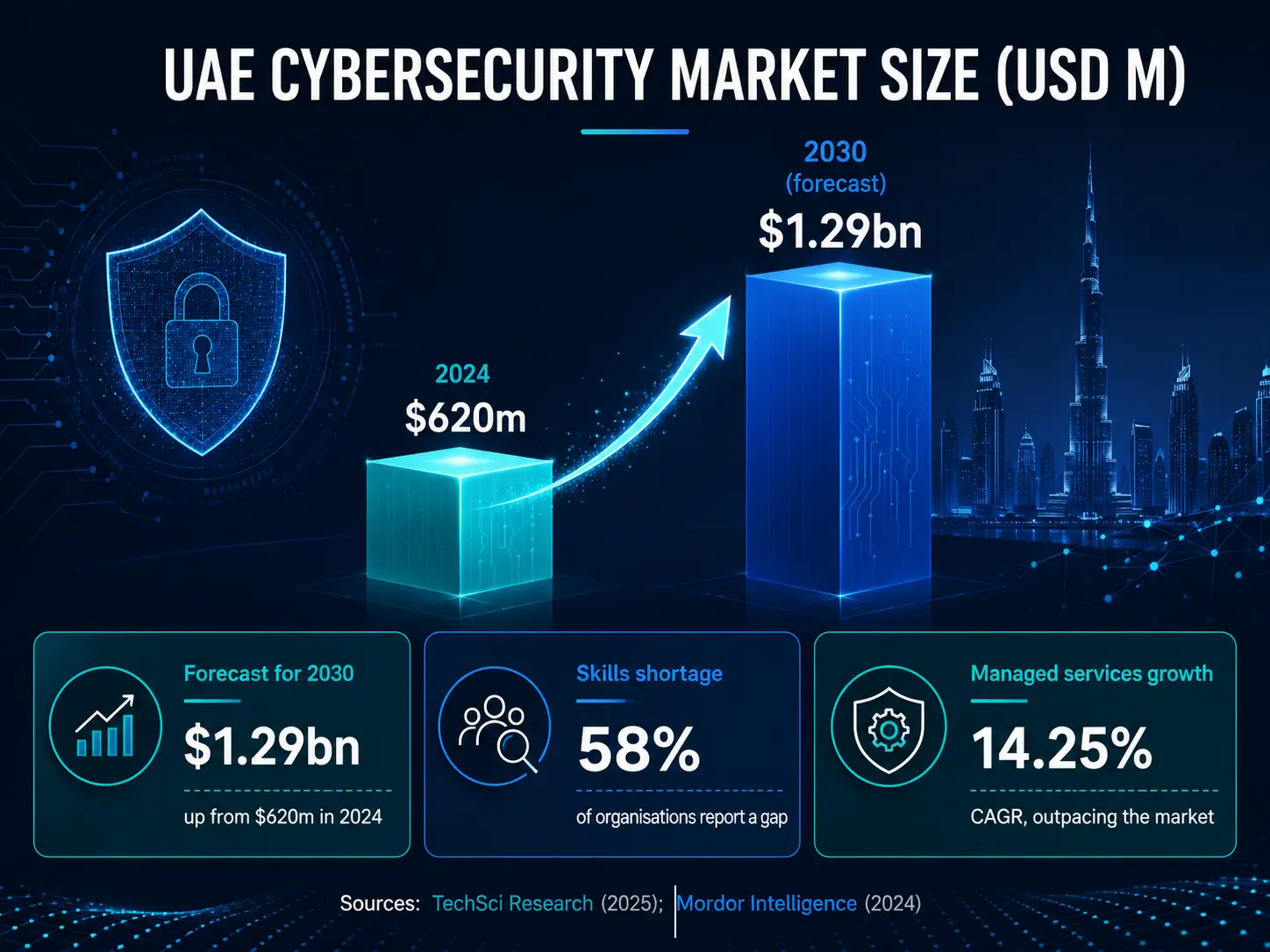
Sources: TechSci Research (2025); Mordor Intelligence (2026).
The UK-to-UAE Opportunity for Cybersecurity
The UAE cybersecurity market was worth USD 620 million in 2024 and is on track to reach USD 1.29 billion by 2030, a 12.8% annual growth rate driven by a genuinely serious threat picture, ransomware hit 73% of UAE organisations between 2021 and 2023, and a workforce gap that 58% of UAE organisations openly admit to.
A UK cybersecurity firm bringing CREST, CHECK, or ISO 27001 credentials into this market is arriving with exactly the kind of proven standard that UAE buyers are actively short of at home.
The UK's own cybersecurity sector, worth £13.2 billion and employing 67,300 full-time professionals, has built deep bench strength in precisely the skills the UAE market needs, penetration testing, managed detection, and compliance consultancy among them, giving a UK firm a real talent and credibility advantage over many local competitors.
Who Your Customers Will Be
Your customer base spans UAE organisations facing a well-documented cybersecurity skills shortage and needing outside expertise to fill the gap, businesses that have already experienced a ransomware incident and are actively rebuilding their defences, and clients who specifically want UK-accredited standards such as CREST, CHECK, or ISO 27001 behind the firm they hire.
The UAE cybersecurity market's growth from USD 620 million in 2024 to a projected USD 1.29 billion by 2030 gives a UK firm a market expanding at 12.8% a year, and with 58% of UAE organisations reporting a skills shortage, demand for outside expertise is not a temporary gap but a structural one that a well-credentialed UK firm is well placed to fill.
Meydan Free Zone or a Direct UK Structure
Selling into the UAE from the UK only needs no local setup, but many enterprise and government-linked clients expect a local entity and local incident response capability before they will sign a contract, particularly for time-sensitive security work.
A Meydan Free Zone entity lets you bid directly, keep 0% corporate tax on qualifying UAE income, and choose from over 2,500 business activities to structure your consultancy, testing, or managed services offering under one company.
[blockCTACostCalculator]
Step-by-Step Setup Guide
- Step 1, book your trade name: Check availability through your chosen free zone authority, confirming your activity covers cybersecurity consultancy, testing, or managed services as needed.
- Step 2, prepare your setup documents: Passport copies of shareholders and directors and a business plan summary covering your service lines and UK accreditations.
- Step 3, get your initial approval and license: Meydan Free Zone's fast digital process moves quickly once your documents are complete.
- Step 4, map your service offering against NESA and UAE Cybersecurity Council standards: Aligning your existing CREST, CHECK, or ISO 27001 credentials against these local reference standards strengthens your pitch to UAE clients.
- Step 5, open your corporate bank account: A local account lets you invoice UAE clients directly and receive payment without routing everything through a UK entity.
- Step 6, register with MOHRE if you employ staff: This sets your visa quota and puts your team under Wage Protection System compliance from the outset.
Compliance and What You Need in Place
Third-party approval
No mandatory third-party license is needed to operate a cybersecurity consultancy or testing firm in the UAE, though alignment with NESA Information Assurance Standards and UAE Cybersecurity Council guidance carries real commercial weight with enterprise and government-linked clients.
UK accreditation as a market advantage
CREST, CHECK, and ISO 27001 credentials earned in the UK translate directly into commercial credibility in the UAE, where these standards are less common locally, so lead with these accreditations in every client conversation.
Anti-money laundering compliance
This activity carries no sector-specific anti-money laundering registration or reporting duties beyond the standard compliance framework that applies to all UAE businesses.
VAT and corporate tax
VAT registration is mandatory once your annual turnover crosses AED 375,000, and 9% corporate tax applies to net profits above the same threshold outside qualifying free zone income, so register directly through the Federal Tax Authority as your business grows.
Talent and delivery capacity
With 58% of UAE organisations reporting a skills shortage, winning work is often the easier part, delivering it needs a real bench of qualified staff, so plan your hiring and visa quota well ahead of signing major contracts.
Ongoing renewals
Renew your license every year, keep your VAT and corporate tax filings current, and keep your MOHRE registrations up to date if you employ staff.
Market Opportunity
The UAE cybersecurity market's growth from USD 620 million in 2024 to a projected USD 1.29 billion by 2030, a 12.8% CAGR, sits on top of a genuinely serious risk picture, with ransomware hitting 73% of UAE organisations between 2021 and 2023, giving a UK cybersecurity firm demand that is both large and urgent rather than speculative.
A skills shortage reported by 58% of UAE organisations means the constraint on this market is talent supply, not client appetite, which favours a UK firm with real delivery capacity behind its credentials.
A UK firm's CREST, CHECK, and ISO 27001 accreditations, built inside a domestic market worth £13.2 billion and employing 67,300 full-time professionals, translate into a real competitive edge in the UAE, where these specific standards remain less common among local providers.
A firm that leads with these credentials while building a local entity through Meydan Free Zone is well placed to win the enterprise and government-linked contracts that specifically call for both proven standards and local presence.
Incident response work in particular rewards a firm with real on-ground capability, since a client facing an active breach needs a partner who can respond in hours, not one coordinating from a UK time zone, so a Meydan Free Zone entity with a locally based response team is well placed to win and keep this higher-value, higher-urgency category of client.
Conclusion
UK Cybersecurity Firm Setup in the UAE is a workable move for a firm ready to bring proven UK standards into a market that badly needs them. Meydan Free Zone's fast setup, tax position, and access to a broad range of business activities give a UK cybersecurity firm a practical route into the UAE's fast-growing security market.
[blockCTAContact]