Table of Contents
Frequently Asked Questions
Is health insurance mandatory in Dubai?
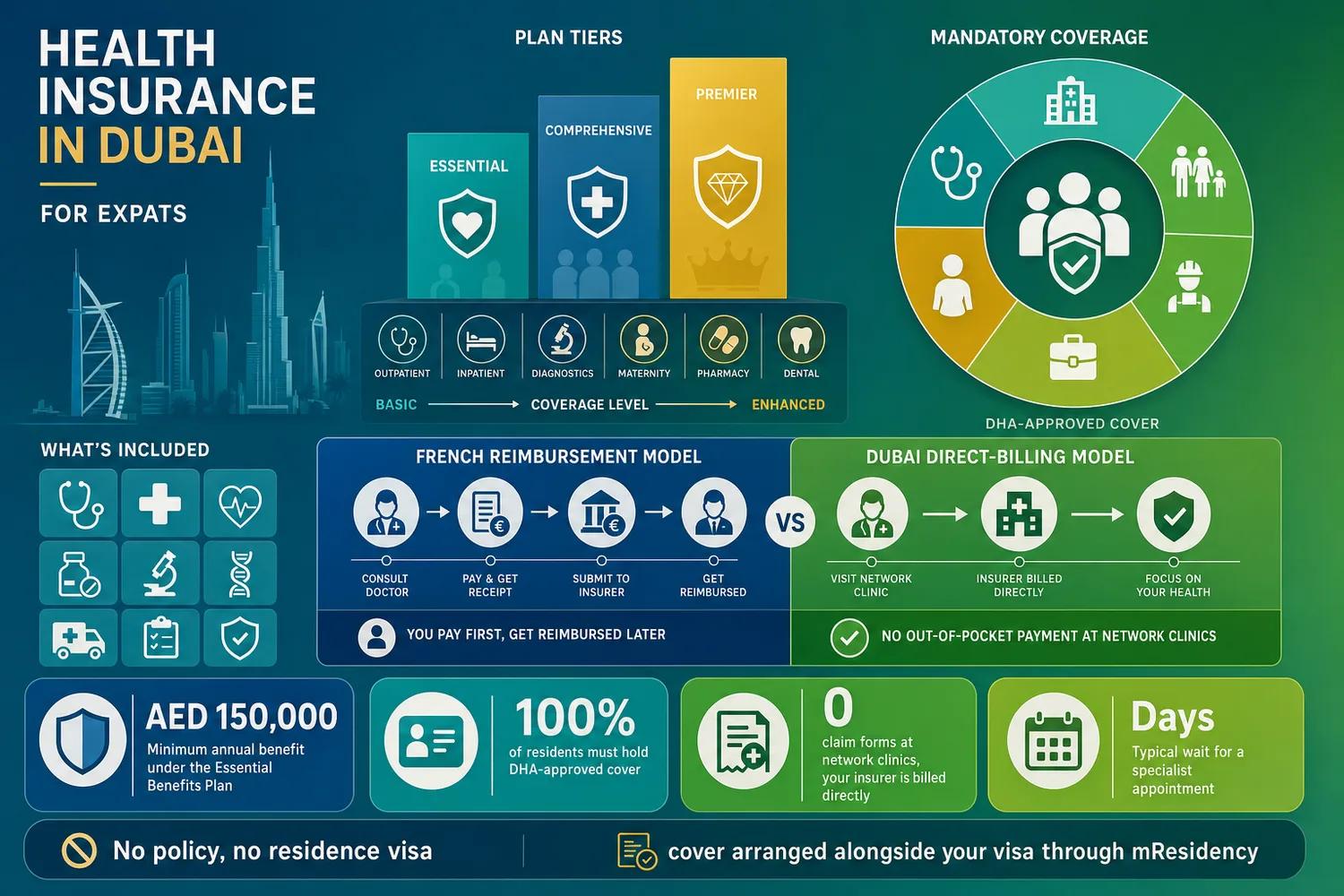
Yes. Under Dubai Law No. 11 of 2013, all residents must hold DHA-approved cover, and your residence visa cannot be issued or renewed without it. The minimum annual benefit limit is AED 150,000.
Can French expats use public hospitals in Dubai?
Public hospitals primarily serve Emirati nationals. As an expatriate resident you use the private system, accessed through your mandatory insurance policy.
How do I pay when I visit a doctor?
At network providers, the clinic bills your insurer directly. You show your Emirates ID and insurance card and pay only your co-payment. Outside the network, you pay upfront and claim back.
What happens to my French healthcare cover?
Sécurité Sociale is not designed for permanent residents abroad, so entitlement generally ends when you leave. The Caisse des Français de l'Étranger is a voluntary alternative worth investigating.
Can I add my family to my policy?
Yes. A spouse and children can be covered as dependants through the same process, arranged alongside your own policy rather than separately.
Topic Summary
Health Insurance Is Mandatory, Not Optional
Every resident in Dubai must hold a Dubai Health Authority-approved policy. Without it, your residence visa cannot be issued. This is a legal requirement that applies to every French expat from day one, not something you arrange after arriving.
You Will Use the Private System
Dubai does have public hospitals, run by the DHA and MOHAP, but most French arrivals use private networks. Private facilities offer faster access, English-language service, and direct billing, meaning you present your insurance card and the provider bills the insurer directly.
The Essential Benefits Plan Is the Minimum Standard
The EBP starts from around AED 650 per year and covers emergency care, basic outpatient visits, and maternity up to defined limits. It satisfies the residence requirement but is rarely sufficient for founders, families, or anyone seeking specialist access.
Enhanced and Comprehensive Plans Cover More Ground
Enhanced plans run from AED 3,000 to AED 8,000 per year and unlock specialist referrals and broader hospital networks. Comprehensive plans from AED 10,000 upward add international emergency cover, which matters for French expats travelling frequently between France and Dubai.
Your French Cover Does Not Transfer
Sécurité Sociale and mutuelle coverage does not meet DHA requirements. French expats who only realise this after submitting their residence application face delays and additional cost. You must verify DHA approval status of any existing plan before assuming it qualifies.
Free Zone Founders Have Employer Obligations
If you hold a Trade License and employ staff, providing minimum EBP coverage from the same month as employment starts is a legal requirement. DHA fines for non-approved employers reach AED 500 per uninsured employee per month, so compliance from day one matters.
Dependent Coverage Requires Its Own Policy
Each family member you sponsor on a dependent visa in Dubai requires their own DHA-approved plan. Coverage must be in place before the dependent residence permit is issued. Family plans typically price 15 to 25 percent lower per person than individual policies with the same insurer.
Dubai Health Insurance Guide for French Expats in the UAE 2026
Good healthcare in Dubai is easier to access than most French arrivals expect. The system is private, appointments are fast, and your insurance is issued alongside your residence visa.
The mechanics differ from home in three ways worth knowing early: cover is private rather than state-funded, clinics bill your insurer directly rather than reimbursing you afterwards, and holding a policy is a condition of residency.
It is a system a large French community already navigates comfortably. Dubai's population has passed 3.9 million across more than 200 nationalities, according to the Dubai Statistics Centre,¹ and France Diplomatie reports more than 26,000 French nationals registered with the consulate, out of an estimated 35,000 living in the country.² Almost all of them use the private system.
This guide explains what public and private healthcare mean here, what your policy covers, and how to use it day to day, including how cover can be arranged through mResidency at Meydan Free Zone as part of your visa process.
What "Public Healthcare" Means in Dubai
Dubai does have public hospitals, run by the Dubai Health Authority. But they primarily serve Emirati nationals. As an expatriate resident, you will use the private system, accessed through your mandatory insurance.
So the real question is not whether to choose public or private. It is which private plan you hold, and how well it works when you need it.
Health Insurance Is Mandatory, Not Optional

Under Dubai Law No. 11 of 2013, health insurance is compulsory for every resident of the emirate. This is not a recommendation. Without valid, DHA-approved cover, your residence visa cannot be issued.
The minimum standard is the Essential Benefits Plan, which carries an annual benefit limit of AED 150,000. Most founders and families take something above that baseline.
What Your Plan Covers
Cover varies by tier, but the general shape is consistent:
- Inpatient care, hospital admissions, surgery and related treatment
- Outpatient care, GP and specialist consultations, diagnostics and prescriptions, usually with a co-payment
- Emergency treatment, covered at any hospital
- Maternity, included on most plans, though waiting periods often apply
- Chronic conditions, covered subject to declaration
- Dental and optical, typically only on comprehensive plans
Pre-existing conditions must be declared when you apply. Failing to declare them is the most common reason a claim is later refused.
Using Your Health Insurance in Dubai
The practical mechanics differ from what a French patient is used to, but they are simpler than they sound.
| Situation | How it works |
|---|---|
| Visiting a network clinic | Present your Emirates ID and insurance card. The provider bills your insurer directly, no forms, nothing to claim back. You pay only your co-payment. |
| Going outside the network | You pay the full amount upfront and claim reimbursement afterwards, which is slower and sometimes partial. Check your insurer's app or portal first. |
| Co-payments | Outpatient visits usually carry a co-pay, commonly a percentage of the consultation fee, with an annual cap. Inpatient treatment is generally covered in full within your policy limits. |
| Planned procedures and scans | Some require pre-authorisation from the insurer. The clinic normally handles this, but confirm it so nothing is delayed on the day. |
| Seeing a specialist | Book directly. There is no equivalent of the médecin traitant referral system, and appointments are typically available within days. |
| Emergencies | Go to the nearest hospital. Emergency care is covered regardless of network, and billing is settled afterwards. |
| Everyday | Carry your Emirates ID. Most clinics can retrieve your insurance details from it alone. |
What Changes When You Move From the French System
Three adjustments matter most:
- The billing model: France reimburses you after treatment, with a mutuelle covering the balance. Dubai bills your insurer directly at the point of care, and instead of adding a top-up policy, you choose a higher plan tier from the outset.
- Your French cover: Sécurité Sociale is not designed for people living permanently abroad, so entitlement generally ends when you leave. The Caisse des Français de l'Étranger is a voluntary scheme for French nationals overseas, worth investigating if you retain ties to France or expect to return, though it merits proper advice.
- The speed: Most French arrivals find specialist access noticeably faster here, with appointments usually available within days rather than weeks.
Choosing the Right Plan
When comparing options, look past the premium and check:
- Network size, and whether the hospitals and clinics near your home and office are in it
- Direct billing, so you are not paying upfront and claiming back
- Maternity cover and any waiting period, if relevant
- Dental and optical, usually only on higher tiers
- Evacuation and repatriation, worth having if you travel or want the option of treatment in France
- Family cover, and how dependants are added
How Meydan Free Zone Arranges It
Because insurance is a condition of residency, the simplest route is to arrange it as part of the visa process rather than approaching insurers yourself.
Through mResidency, the medical insurance application is initiated with an approved provider, such as Orient, on your behalf. Here is how it works:
- Applied for through the customer portal, selecting the relevant category: investor, employee, or dependant.
- Minimal information required, typically your name, contact details, marital status, BMI and any declared chronic conditions. Pre-existing conditions must be disclosed at this stage.
- The policy certificate is issued on approval, and it is this document that allows your residency and visa steps to proceed.
- A Table of Benefits comes with it, setting out exactly what is covered, the limits, network access and exclusions. Worth reading properly rather than filing away.
- Family can be included, with a spouse and children covered as dependants through the same process.
The benefit is sequencing. Insurance, the medical test, the Emirates ID and your visa move together as one process rather than four separate errands. For a French founder arriving without local contacts, that removes the most common cause of delay.
There are two limitations worth knowing upfront. The cover within the Meydan Free Zone package is issued at a set level and cannot be upgraded, so higher limits or international cover means arranging a separate policy independently. And renewal is annual and handled directly with the insurer rather than through the portal, letting it lapse disrupts your residency status.
In Conclusion
Healthcare in Dubai is private, mandatory and, once you understand the mechanics, straightforward. You hold a DHA-approved policy, you use clinics inside your network, the provider bills your insurer directly, and you see a specialist within days rather than weeks.
The two things worth getting right early are your plan level, particularly if you have a family, and having the cover in place as part of your residency rather than as an afterthought.
To arrange your company, residency and insurance together, book a free consultation with a setup advisor at Meydan Free Zone.
Footnotes
¹ Dubai Statistics Centre,Economic relations between France and the United Arab Emirates, Dubai's resident population exceeds 3.9 million across more than 200 nationalities, 2026.
² France Diplomatie, Population Clock, over 26,000 French nationals are registered with the consulate out of an estimated 35,000 in the UAE, 2026.