
Table of Contents
Frequently Asked Questions
Can UK expats use public hospitals in Dubai?
Yes, but they pay, either out of pocket or through insurance, as free public care is for Emirati citizens. Most expats use private clinics for speed, keeping public hospitals for major emergencies.
What is a network in Dubai health insurance?
A network is the list of hospitals and clinics your plan covers. Inside it, your insurer is billed directly and you pay only a co-pay. Outside it, you may pay the full bill yourself.
What is a co-pay in Dubai?
A co-pay is the small share you pay on a visit, often around 20 percent up to a cap, or a fixed amount. Your insurance covers the rest at network providers.
Do I pay upfront for treatment in Dubai?
Usually not at network providers. You show your Emirates ID, the clinic bills your insurer directly, and you pay only your co-pay. This cashless, direct-billing setup covers most everyday care.
Should I keep my UK health insurance when I move to Dubai?
A standard UK policy will not cover you as a Dubai resident. You need a DHA-approved local plan, or an international plan if you want cover that also works back in the UK.
Topic Summary
Health Insurance Is Mandatory, Not Optional
Under Dubai Law No. 11 of 2013, every resident must hold a DHA-approved policy. UK expats cannot receive a residence visa or renew it without active cover in place — there is no grace period and no NHS equivalent to fall back on.
Public Hospitals Exist, But Are Not Free for Expats
Dubai has public hospitals managed by the Dubai Health Authority, including Rashid Hospital and Dubai Hospital. UK expats can access them, but fees apply without a government-sponsored card. Most expats use private facilities as their default.
Private Healthcare Is the Standard Choice
Private hospitals like Mediclinic and American Hospital Dubai offer short wait times, English-speaking staff, and international accreditation. With a mid-tier DHA-approved plan, UK expats typically see a specialist within 24 to 48 hours.
Plan Tiers Range from AED 600 to AED 15,000+ Per Year
Basic Essential Benefits Plans start from roughly AED 600 annually but carry narrow hospital networks and annual caps. Mid-tier plans run AED 5,000 to 15,000 and suit most UK expats, while comprehensive plans add maternity, dental, and optical cover.
Pre-Existing Conditions Must Be Declared Upfront
UK expats moving from NHS care must declare all pre-existing conditions to insurers. Failing to do so is the most common reason claims are denied. Some plans exclude certain conditions or apply waiting periods, so read policy terms carefully before committing.
Your Trade License Unlocks the Residency That Triggers Cover
A Meydan Free Zone Trade License from AED 12,500 enables UK entrepreneurs to self-sponsor their residence visa. That visa is what activates the mandatory health insurance requirement — the license is the foundation the entire chain depends on.
No UK Prescriptions Are Valid in Dubai
UK prescriptions do not transfer to Dubai. Register with a DHA-licensed GP on arrival to establish prescription continuity. Most common UK medications have approved equivalents available across private pharmacies and hospital networks across the emirate.
Healthcare and Medical Insurance in Dubai, UAE for UK Expats: Complete Guide
You have your residence visa and a health insurance policy to go with it. Now comes the part nobody explains: how do you actually use it? Coming from the NHS, where you just turn up and everything is free, Dubai's system takes a little learning.
The good news is that it is simple once you know the rules. You pick a hospital inside your network, you show your Emirates ID, and your insurance handles the bill, sometimes with a small co-pay. This guide explains public versus private, how to choose a plan, and how claims, networks and co-pays really work.
Key Facts at a Glance
Here are the things every UK expat needs to know about using healthcare in Dubai.
| Is insurance mandatory | Yes, it is tied to your residence visa under DHA rules |
|---|---|
| Public or private | Most expats use private clinics and hospitals for daily care |
| How you are identified | Your Emirates ID is becoming the main patient identifier |
| What you pay on a visit | Often a small co-pay, with insurance covering the rest |
| Where care is covered | Only at providers inside your plan's network |
Public vs Private: Which to Use When
Dubai has both public and private healthcare, and both are regulated by the Dubai Health Authority. The two work differently for expats, so it helps to know when to use each.
Public healthcare
Public hospitals like Rashid, Dubai and Latifa are strong, especially for emergencies and trauma. Care is free for Emirati citizens, but expats pay, either out of pocket or through insurance. A public consultation is cheap, often AED 100 to 200. The catch is that public hospitals mainly serve citizens, so waits can be longer for expats.
Private healthcare
This is where most British expats spend their time. Private clinics and hospitals are fast, modern and used to international patients. You can book a specialist directly, often within days, with no GP referral. The cost is higher, a private consultation runs AED 300 to 700, but your insurance is built to cover it.
The simple rule: use private care for speed and convenience day to day, and know that public hospitals are there for major emergencies.
How to Choose the Right Plan
Your plan decides where you can go and what you pay. Getting this right matters more than any other healthcare decision you make here.
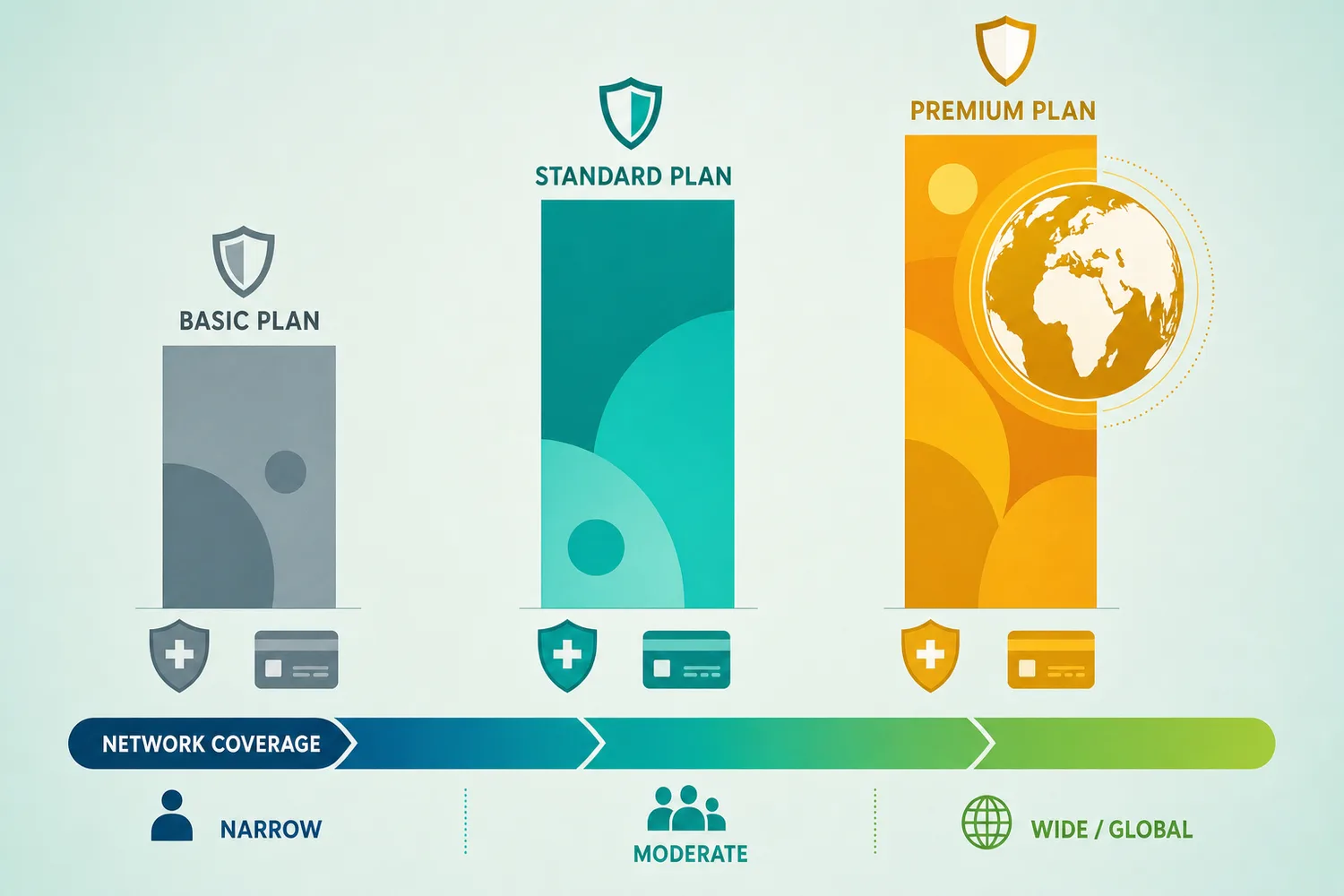
- Essential Benefits Plan (EBP): The legal minimum, for workers earning under AED 4,000 a month. It has an annual cap of AED 150,000 and a narrow network. It is cheap, but limited.
- Enhanced plans: These cost more but open up better hospitals, higher limits and wider cover. Most UK expats want this level.
- International plans: The top tier. These can cover treatment back in the UK and worldwide, which suits founders who travel.
Here is how the main levels compare.
| Plan level | What it covers | Best for |
|---|---|---|
| Essential Benefits Plan (EBP) | Legal minimum, AED 150,000 annual limit, narrow network, GP-led with referrals | Workers earning under AED 4,000 a month |
| Enhanced plan | Higher limits, wider hospital network, direct specialist access, some maternity | Most working British expats and founders |
| International plan | Worldwide cover, often including treatment back in the UK, highest limits | Frequent travellers and families wanting UK cover |
The mistake to avoid is taking the cheapest plan and assuming it works like the NHS. It does not. Choose the level that matches the care you actually expect to use.
Free Business Setup Cost Calculator
Calculate NowHow Networks, Co-pays and Claims Work
This is the part that feels new to Brits, because the NHS never asked you to think about it. Here is how it works in practice.
Networks
Every plan comes with a network, a list of hospitals and clinics it covers. Go to a provider inside your network and your insurance pays directly. Go outside it and you may pay the full bill yourself, then claim some back. Always check a clinic is in your network before you book.
Direct billing
At most network providers, you do not pay and claim later. You show your Emirates ID, the clinic bills your insurer directly, and you only pay your co-pay. This is the smooth, cashless way most care works.
Co-pays
A co-pay is the small share you pay on a visit, often 20 percent of the consultation up to a cap, or a fixed amount. It keeps your premium lower and is normal here.
Pre-authorisation
For bigger treatments, surgery, scans, some specialist work, your insurer may need to approve it first. Your clinic usually handles this for you, but it is worth knowing why a treatment might wait a day for sign-off.
How to Set Up and Use Your Cover
Getting the practical side right takes a few simple steps.
- Step 1, link your policy to your Emirates ID: Your Emirates ID is becoming the main patient identifier, so an unlinked policy can show as inactive even when it is valid.
- Step 2, save your network list: Keep your insurer's app or provider list handy, so you always know where you are covered.
- Step 3, register with a network clinic: Pick a nearby hospital or clinic inside your network for routine care.
- Step 4, carry your Emirates ID: It is what you show at reception for cashless, direct-billed treatment.
The Catch Nobody Mentions: It All Starts With Your Visa
You cannot hold a valid policy without a residence visa, and you cannot finish your residence visa without a policy. The Emirates ID you show at every clinic only exists once both are done. Healthcare is really the last link in a chain that starts with your residency.
For a British founder, that chain starts with a company. It also shapes the cover you buy:
- You are self-sponsored: As a business owner you arrange your own individual policy, rather than getting it from an employer, so the plan choice is yours.
- The plan level is your call: The basic EBP is a GP-led plan with a strict referral system, while an enhanced plan lets you book specialists directly, the fast, private care most expats move here for.
- The company unlocks the visa: Owning a Meydan Free Zone company is what makes you eligible for the residence visa behind all of this.
- mResidency runs it in order: It handles the visa, the mandatory medical test and the Emirates ID, so you are not stuck waiting on one thing to unlock another.
- Fawri adds speed: Founders who want to move fast can get a Fawri license online in under 60 minutes and start from the UK before they fly out.
Common Mistakes UK Expats Make
A few slip-ups come up again and again. They are easy to avoid once you know them.
- Taking the basic EBP and expecting NHS-level cover
- Booking a clinic that sits outside your network, then facing the full bill
- Forgetting to link the policy to their Emirates ID
- Assuming a UK private policy still works once they are a Dubai resident
- Not knowing that pre-existing conditions are often excluded for the first six months
Conclusion
Using health insurance in Dubai is simple once the basics click. Stay inside your network, show your Emirates ID for cashless care, expect a small co-pay, and pick a plan that matches the care you want rather than the legal minimum.
Get those right and the day to day feels easy, often faster and more comfortable than the NHS waits you left behind. The one rule to remember: your cover is only as good as the plan you choose, so choose it with care.
Ready to Launch Your Business in Dubai?
Let's ConnectReferences