Table of Contents
Frequently Asked Questions
Can an employer end a contract without notice in the UAE?
Yes, but only on the specific grounds listed in Article 44 of Federal Decree-Law No. 33 of 2021, and only if the employer can prove them. Outside those grounds, the employer must give written notice within the contract and legal limits. Dismissal without a provable ground can be treated as arbitrary dismissal.
Which offences justify instant dismissal under Article 44?
The listed grounds include assuming a false identity or submitting forged documents, deliberate acts causing serious loss, serious breach of safety instructions, disclosing confidential business secrets, working under the influence of alcohol or drugs, assault at work and prolonged unjustified absence. Each ground needs documented evidence. Poor performance and missed targets are not listed grounds.
Does an employee lose end-of-service gratuity after a dismissal without notice?
Not automatically. A justified dismissal does not cancel accrued wages or unused leave pay, and gratuity treatment depends on the wording of the law. Employers should check the official text of Federal Decree-Law No. 33 of 2021 on MOHRE before making any deduction. Withholding dues as leverage creates further dispute risk.
Can a dismissed employee challenge the termination?
Yes. The employee can file a complaint with MOHRE, which first attempts an amicable settlement between the parties. If that fails, the case can move to the labour court. The employer must then show evidence that the dismissal fell within an Article 44 ground.
How many days of absence justify dismissal without notice?
Article 44 allows dismissal without notice for absence without a valid reason of more than 20 intermittent days in a year, or more than seven consecutive days. The absence must be documented through attendance records and written notices. Match the employee's record to these thresholds before acting.
Must an employer issue a written warning before dismissing under Article 44?
For most grounds, Article 44 does not require a prior warning, but it does require a written investigation with the employee first. Failure to perform core duties is different: it needs two written warnings that a repeat will lead to dismissal. A termination letter citing the exact ground strengthens the employer's position.
What compensation can a worker claim for arbitrary dismissal?
If a dismissal is found to be arbitrary, the competent body may award compensation based on the circumstances of the case, subject to the limits in Federal Decree-Law No. 33 of 2021. Notice pay and other outstanding dues may be added to a successful claim. Employers should read the compensation provision in the official text.
Does Article 44 apply to employees of a Meydan Free Zone company?
A Meydan Free Zone company should treat Article 44 as a compliance reference and build written contracts, conduct policies and documented procedures from the first hire. The authority that handles a labour complaint depends on the company's jurisdiction, so employers should not assume mainland processes apply by default. Meydan Free Zone's mResidency pillar covers residency visas, which supports the visa side of onboarding and exit.
Topic Summary
What Article 44 of the UAE Labour Law Means for Employers
Article 44 of Federal Decree-Law No. 33 of 2021 lists the serious grounds on which a private-sector employer may end a worker's contract without notice. It covers conduct such as forged documents, serious safety breaches and repeated unexplained absence. The employer must prove the ground.
Grounds for Dismissal Without Notice Under Article 44
Article 44 permits dismissal without notice in defined cases. These include false identity or forged documents, serious loss caused by the employee, breach of written workplace rules, and repeated failure of core duties after warnings. Others are disclosure of business secrets, intoxication at work, assault, prolonged unjustified absence and misuse of position. In every case, the employer must first hold a written investigation.
How Termination Without Notice Works in the UAE
Termination without notice works when the employer follows a documented process: investigate in writing, let the employee respond, issue a written termination citing the exact ground, then cancel the work permit and settle dues. Missing evidence is a common reason cases fail.
Steps to Follow Before Dismissing an Employee Under Article 44
Before relying on Article 44, confirm the ground is listed, collect written evidence, hear the employee, issue a written letter and settle all dues. This sequence reduces arbitrary dismissal risk.
Risks and Compliance Mechanics Employers Should Plan For
If an Article 44 dismissal isn't upheld, the employee can claim arbitrary dismissal, and the employer may owe compensation, notice pay and other dues. Disputes start with MOHRE mediation and can reach court. Weak evidence is the main financial risk.
How Article 44 Applies to a Meydan Free Zone Company
A Meydan Free Zone company should build Article 44 into its employment framework, with written contracts and documented procedures from day one. Free zones have their own employment regulations, with Federal Decree-Law No. 33 of 2021 as the baseline, so confirm with Meydan Free Zone how labour complaints are handled for your staff.
Conclusion
Article 44 gives employers a narrow route to end a contract without notice, and it rewards preparation over speed. Match conduct to a listed ground, hold the evidence, and follow the process through to final settlement.
Article 44 of the UAE Labour Law: Dismissal Without Notice Explained
Ending a contract without notice can look like a clean, fast option once an employee has clearly crossed a line. In practice, it's one of the most contested decisions a founder can make, and an employer who can't prove the ground carries the cost. This guide covers what Article 44 allows, the evidence you need, the risks, and how the rule fits a Meydan Free Zone company.
What Article 44 of the UAE Labour Law Means for Employers
Article 44 of Federal Decree-Law No. 33 of 2021 lists the serious grounds on which a private-sector employer may end a worker's contract without notice. It covers conduct such as forged documents, serious safety breaches and repeated unexplained absence. The employer must prove the ground.
The Legal Basis in Federal Decree-Law No. 33 of 2021
Private-sector employment is governed by Federal Decree-Law No. 33 of 2021, which replaced Federal Law No. 8 of 1980. The Ministry of Human Resources and Emiratisation (MOHRE) administers the law and its executive regulations.
Article 44 is an exception to the normal notice requirement. It isn't a general right to dismiss quickly. Say a founder decides a manager's poor performance justifies instant dismissal. On its own it doesn't: the closest ground needs a written investigation and two written warnings first.
Dismissal Without Notice Versus Standard Termination
Standard termination requires written notice, with the period set in the contract within legal limits. Article 44 removes that obligation only where a listed ground is proven. Misusing it is a common reason employers lose arbitrary dismissal claims.
Picture two employees leaving on the same day. One is dismissed with notice for restructuring, the other without notice for forged credentials. The legal footing is entirely different. For the wider rules, read redundancy and dismissal under UAE labour law.
Article 44 Dismissal Compared With Standard Termination
| Feature | Dismissal Without Notice (Article 44) | Standard Termination With Notice |
|---|---|---|
| Legal basis | A listed ground in Article 44 of Federal Decree-Law No. 33 of 2021 | The contract and the notice rules in the same law |
| Notice period required | None, if the ground is proven | Written notice for the period set in the contract |
| Burden of proof on employer | High: records, reports and the employee's response | Lower, but the reason must still be genuine |
| Typical trigger | Forged certificate, safety breach, assault, prolonged absence | Restructuring, underperformance, role changes |
| Main dispute risk | Claim that the ground was unproven or not listed | Claim that the reason was arbitrary |
Grounds for Dismissal Without Notice Under Article 44
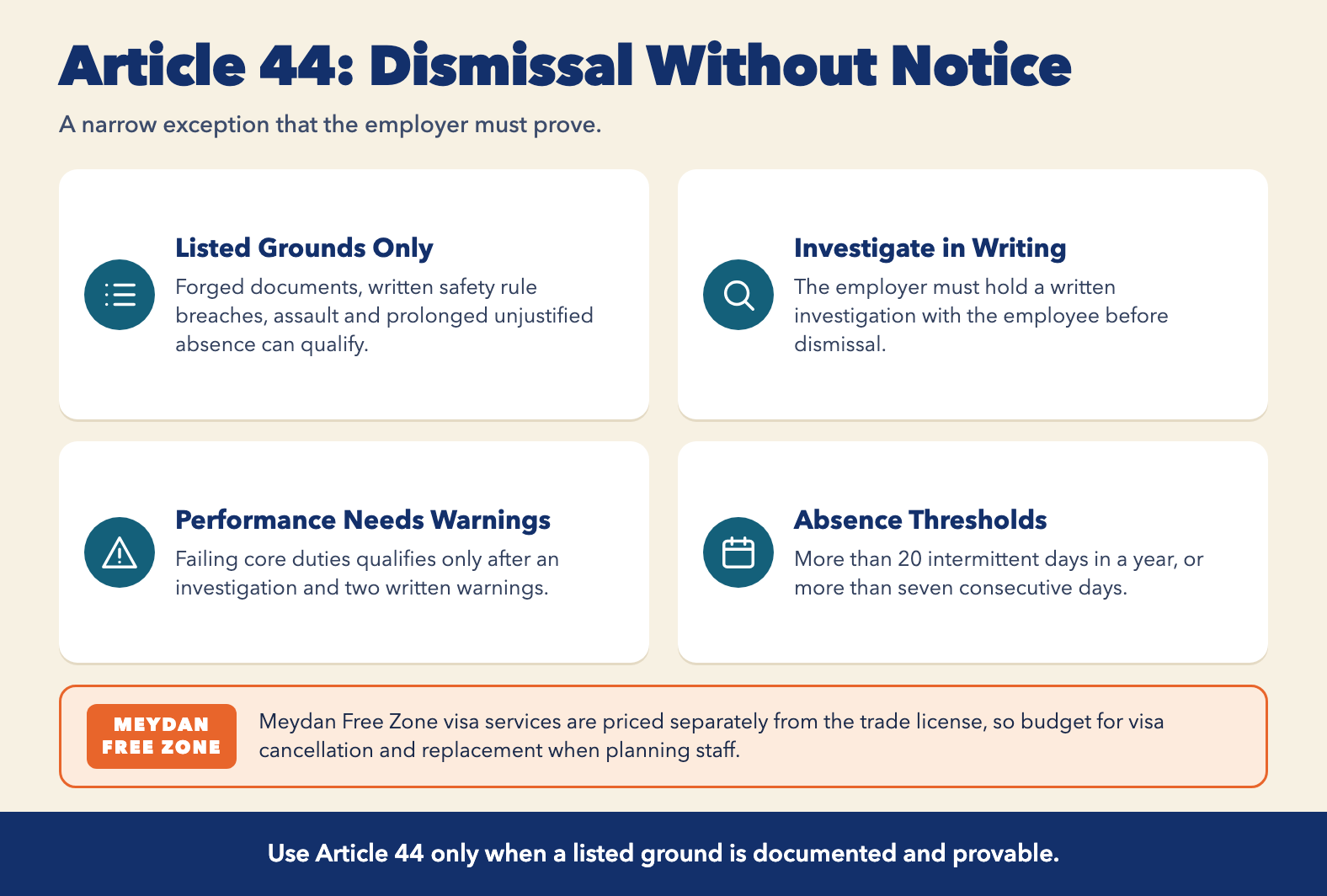
Article 44 permits dismissal without notice in defined cases. These include false identity or forged documents, serious loss caused by the employee, breach of written workplace rules, and repeated failure of core duties after warnings. Others are disclosure of business secrets, intoxication at work, assault, prolonged unjustified absence and misuse of position. In every case, the employer must first hold a written investigation.
Misconduct and Fraud Grounds
- Assuming a false identity or submitting forged documents or certificates.
- Errors or deliberate acts that cause the employer serious loss, where the employer notifies MOHRE within seven working days of learning of it.
- Disclosing confidential business secrets. A non-compete clause is a separate matter.
Take an employee who presented a falsified degree at onboarding, found after a credential check. That fits squarely.
Safety, Conduct and Absence Grounds
- Breach of written workplace or safety rules that are posted visibly and that the employee was told about.
- Being under the influence of alcohol or drugs during working hours.
- Assaulting the employer, a manager or a colleague at work.
- Absence without a valid reason for more than 20 intermittent days in a year or more than seven consecutive days.
A warehouse worker ignores a signed safety protocol and causes an injury. The employer holds the protocol and the incident report, so the ground is provable.
What Does Not Qualify
Underperformance and missed targets alone aren't Article 44 grounds, unless the core-duties process of investigation and two written warnings has been followed. A business downturn is redundancy. A sales lead who misses targets for two quarters usually needs standard notice. Probation has its own rules, covered in the probation period guide.
How Termination Without Notice Works in the UAE
Termination without notice works when the employer follows a documented process: investigate in writing, let the employee respond, issue a written termination citing the exact ground, then cancel the work permit and settle dues. Missing evidence is a common reason cases fail.
Evidence and Documentation Standards
- Written warnings, incident reports, CCTV logs and attendance records.
- Signed policies the employee acknowledged.
- A written investigation with the employee, which the law requires before dismissal.
An employer with timestamped attendance records and two emailed absence notices can defend a dismissal. One with verbal warnings only can't.
The Termination Letter and Visa Cancellation
The letter should state the ground, the incident date and the evidence relied on. "Violation of company policy" isn't enough. Permit and visa cancellation follow, as set out in the employment visa cancellation guide. Final dues are owed even when dismissal is justified.
Steps to Follow Before Dismissing an Employee Under Article 44
Before relying on Article 44, confirm the ground is listed, collect written evidence, hear the employee, issue a written letter and settle all dues. This sequence reduces arbitrary dismissal risk.
- Match the conduct to a listed ground. A forged certificate matches. Persistent lateness doesn't. If nothing fits, use standard notice.
- Gather and preserve evidence. Export attendance logs and email trails the day the issue surfaces, before system access ends. Take written witness statements.
- Hear the employee's response. Hold a documented meeting or ask for a written reply. Record it even when it's weak, such as illness claimed without a medical certificate.
- Issue the written termination. Cite the ground and facts. Deliver by hand and email with signed acknowledgement.
Risks and Compliance Mechanics Employers Should Plan For
If an Article 44 dismissal isn't upheld, the employee can claim arbitrary dismissal, and the employer may owe compensation, notice pay and other dues. Disputes start with MOHRE mediation and can reach court. Weak evidence is the main financial risk.
Arbitrary Dismissal Claims and Compensation
Federal Decree-Law No. 33 of 2021, published by MOHRE, caps arbitrary dismissal compensation at three months of wages, assessed on the circumstances. Notice pay may be added. Say an employer dismisses a driver for absence, but records show approved leave: the claim is likely to succeed.
End-of-Service Entitlements and Final Dues
A justified dismissal doesn't cancel accrued wages or leave pay. Check gratuity treatment against the law text before any deduction, using the end of service benefits guide. Never withhold dues as leverage. Finance teams should calculate unused leave before the letter goes out.
Dispute Routes Through MOHRE and the Courts
A complaint filed with MOHRE leads first to an attempt at amicable settlement. The employer attends with its evidence file. Unresolved cases go to the labour court. See labour disputes in Dubai for the process.
How Article 44 Applies to a Meydan Free Zone Company
A Meydan Free Zone company should build Article 44 into its employment framework, with written contracts and documented procedures from day one. Free zones have their own employment regulations, with Federal Decree-Law No. 33 of 2021 as the baseline, so confirm with Meydan Free Zone how labour complaints are handled for your staff.
Contracts and Documentation Set Up at Hiring
Write conduct rules, safety instructions and confidentiality terms into the contract so grounds can be evidenced later. A solo founder hiring a first operations employee should have a signed contract and conduct policy before the start date.
Visa Cancellation After a Dismissal
mResidency covers residence visa services, including medical fitness tests, Emirates ID and medical insurance. Visa services are priced separately from the trade license. After a dismissal, cancel the employee's residence visa promptly and close the file, confirming the steps with Meydan Free Zone.
Free Business Setup Cost Calculator
Calculate NowConclusion
Article 44 gives employers a narrow route to end a contract without notice, and it rewards preparation over speed. Match conduct to a listed ground, hold the evidence, and follow the process through to final settlement.
Before hiring, put written contracts and conduct policies in place. With Meydan Free Zone, visa services are priced separately from the trade license, so include visa cancellation and replacement in your staffing budget.
Ready to Launch Your Business in Dubai?
Let's Connect