

Table of Contents
Frequently Asked Questions
Can a UK expat buy a car in Dubai?
Yes. Once you have a residence visa and Emirates ID, you can buy, finance and register a car in your name. You also need a UAE driving license, converted from your UK one.
How much deposit do I need to finance a car in Dubai?
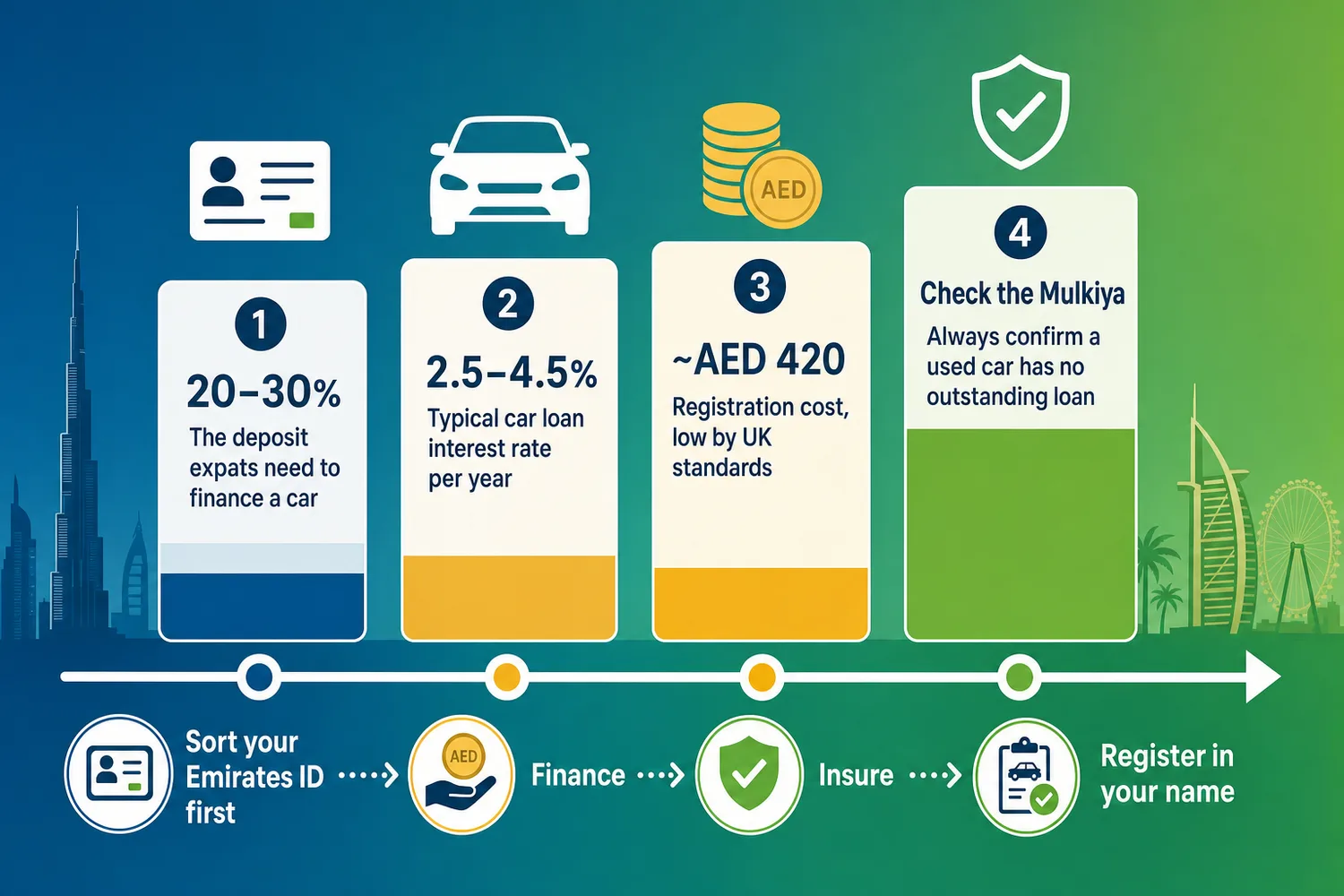
Usually 20 to 30 percent of the car price. Banks also want a residence visa, a salary certificate, and a minimum income, often around AED 5,000 to 8,000 a month.
What is a Mulkiya?
The Mulkiya is your car's registration card. It proves ownership, links the car to your Emirates ID, and is valid for one year. You need it to drive legally and to insure the car.
Is it safe to buy a used car with a loan on it in Dubai?
Yes, if handled correctly. The seller's loan must be cleared first. Pay the financing bank, not the seller, and wait for the No Objection Certificate before the ownership transfer.
Do I need insurance before registering a car in Dubai?
Yes. Valid insurance in your name is required before the RTA will register or transfer a car to you. You can buy a policy online or at the registration centre before completing the transfer.
Topic Summary
UAE Residency Comes First
Buying a car in Dubai starts with a valid UAE residence permit. UK nationals cannot register a vehicle without one — but a Meydan Free Zone Trade License from AED 12,500 provides the legal foundation to obtain that residency quickly.
UK Licence Converts Without a Road Test
British nationals are on the RTA's approved country list, meaning your UK driving licence exchanges directly for a UAE licence — no theory test, no road test. An eye test and your Emirates ID are all that's required.
Bank Financing Is Readily Available
UAE banks finance up to 80% of a vehicle's value for salaried expats, with loan tenors capped at 60 months by the Central Bank of the UAE. Rates typically run between 2.5% and 4.5% per annum, with a 20% deposit required.
Car Registration in Dubai Follows a Clear Process
Car registration in Dubai runs through the RTA and requires valid insurance, a fitness test for used vehicles, and document submission. New cars are registered by the dealer; used transfers take two to three working days.
Insurance Is Mandatory Before Registration
The RTA will not register or renew any vehicle without a valid policy from a Central Bank-licensed insurer. Comprehensive cover runs AED 2,500–AED 12,000+ annually; many UK insurers will recognise your no-claims history.
Owning a Car in Dubai Carries Predictable Running Costs
Owning a car in Dubai means budgeting for annual registration renewal (AED 290–1,200), Salik tolls at AED 4 per crossing, fuel — which is significantly cheaper than in the UK — and annual servicing at AED 800–2,500.
Free Zone Residents Hold Identical Ownership Rights
A licensed free zone company gives UK nationals the same vehicle ownership rights as any mainland resident. There are no additional restrictions — your residence permit, Emirates ID, and UAE driving licence are all that's needed to buy, finance, and register a car.
Buying a Car in Dubai, UAE as a UK Expat: Registration, Financing & Ownership Guide
In Dubai, a car is less a luxury and more a daily need. Public transport works, but most residents drive. The good news for a UK expat is that buying a car here is quick, and the market is huge, from affordable used runabouts to brand-new models.
This guide covers the whole process. It walks through new versus used, how financing works for expats, the registration steps, and what ownership actually means once the car is yours. If you are planning your first car in Dubai, this is what to know.
Key Facts at a Glance
| Point | Detail |
|---|---|
| Can expats buy a car? | Yes, once you have a residence visa and Emirates ID |
| New or used | Both are easy to buy; used needs a few extra checks |
| Financing | Available to residents, usually 20 to 30 percent down |
| Registration | Done at the RTA; the Mulkiya is your ownership card |
| Insurance | Required before the car can be registered in your name |
What You Need Before You Buy
A few things must be in place first. Without them, you cannot register or finance a car.
- A valid UAE residence visa.
- An Emirates ID, which the Mulkiya is linked to.
- A UAE driving license, converted from your UK one at the RTA.
- A UAE bank account, needed if you plan to finance.
You do not strictly need residency to drive, but you do need it to own and register a car properly. That is the point most UK expats reach first.
New or Used: Which to Choose?
The first decision is new or used. Both are simple to buy in Dubai, and each suits different budgets.
- New cars come with a warranty, lower early maintenance, and no inspection needed for the first three years. Dealers often bundle servicing and finance.
- Used cars are cheaper and lose value more slowly once someone else has taken the first hit. They need a history check and a passing test before transfer.
Popular brands like Toyota, Nissan and Lexus hold their value well here, which matters if you plan to sell before you leave.
How Car Financing Works for Expats
Most UK expats spread the cost with a car loan. UAE banks lend to residents, and the market is competitive.
- You usually need a residence visa, a salary certificate, and a minimum income, often around AED 5,000 to 8,000 a month.
- A down payment of 20 to 30 percent of the car price is standard.
- Interest rates typically run between 2.5 and 4.5 percent a year.
- A processing fee of about 1 percent of the loan is common.
- Pre-approval often comes within 24 to 48 hours for a clear application.
Sharia-compliant car finance is also widely available if you prefer it. Compare a few banks, since rates and terms vary.
Free Business Setup Cost Calculator
Calculate NowRegistering Your Car in Dubai
Registration is what makes the car legally yours to drive. The Mulkiya, your registration card, is the proof. It links the car to your Emirates ID and lasts one year.
For a new car, the dealer usually handles registration for you. For a used car, the steps are yours:
- Step 1, check the car: Get the chassis number and confirm its history and any accidents.
- Step 2, clear any loan: Make sure the seller has settled any finance, so there is no lien on the car.
- Step 3, pass the test: Take the car to an RTA-approved centre like Tasjeel or Shamil for its test.
- Step 4, insure it first: Buy insurance in your name before the transfer, as the RTA requires it.
- Step 5, transfer and pay: Present your documents, pay the fees, and receive your Mulkiya on the spot.
Registration fees are low. Expect around AED 420 for a new car, plus about AED 350 for a used-car transfer and AED 120 for the test. A first-time traffic file adds about AED 220.
Buying a Used Car With an Outstanding Loan
Many used cars still have finance owing on them, and that must be cleared before you can own the car.
- Ask the seller for a photo of the current Mulkiya before agreeing anything.
- If a bank name appears on it, the car has a lien and cannot transfer until it is cleared.
- Never pay the seller directly. Pay the financing bank, and wait for the No Objection Certificate.
A financed car is safe to buy once the lien is released. Skipping this check is where buyers get caught out.
What Ownership Means in Dubai
Owning a car here comes with a few running costs worth planning for.
- Annual registration renewal, around AED 400 to 1,000 depending on the car.
- Comprehensive insurance, roughly 2.5 to 4 percent of the car's value each year.
- Salik, the electronic toll, charged each time you pass a gate.
- Fuel, which is cheap by UK standards, so running costs feel lower.
The Mulkiya must be renewed every year, and insurance must stay valid for the renewal to go through.
The Emirates ID sits behind every step. The bank needs it to approve finance. The insurer needs it to issue a policy. Your Mulkiya is registered against it. Without one, you cannot own a car in your name.
That is where Meydan Free Zone fits your move. Your Emirates ID comes from a UAE residence visa, and that visa comes from owning a company.
- The company gives you the visa: A Meydan Free Zone company makes you eligible for residency, with a Fawri license issued in under 60 minutes if you want speed.
- mResidency handles the Emirates ID: It runs your entry permit, medical, biometrics and EID in one process.
With the Emirates ID in hand, the rest falls into place: convert your UK license, finance, insure and register, all in your name. So the order is residency first, because the Emirates ID is the key everything turns on.
Conclusion
Buying a car in Dubai as a UK expat is fast once your paperwork is ready. Decide new or used, arrange finance if you need it, check any used car for an outstanding loan, and register it to get your Mulkiya.
Get your residency and Emirates ID in place first, since everything else depends on them. To set up the company and residency behind your move, book a free consultation with a setup advisor at Meydan Free Zone.
Ready to Launch Your Business in Dubai?
Let's ConnectReferences