

Table of Contents
Frequently Asked Questions
Do I need a UAE license to sell on Amazon.ae or Noon?
Yes. Both require a valid UAE trade license to onboard as a seller. A UK-registered business cannot list on them directly, so a UAE e-commerce license is the essential first step.
Which e-commerce model is best for a British seller in Dubai?
It depends on your goal. Marketplaces like Amazon.ae give fast reach for platform fees, your own store keeps margin and customer data, and dropshipping lets you test products with low upfront cost.
Can Meydan Free Zone help me set up my marketplace seller accounts?
Yes. The E-commerce Starter service, for AED 1,000, sets up seller accounts on two top UAE marketplaces and lists one product on each, meeting each platform's requirements so you avoid onboarding delays.
How do I get paid from UAE sales if I bank in the UK?
A multi-currency account through Meydan's partners holds GBP, AED and USD together, so you collect UAE sales in dirhams and convert only when it suits you, avoiding a charge on every transfer.
Do I pay tax on a Dubai e-commerce business?
There is no personal income tax. Corporate tax of 9 percent applies only to profits above AED 375,000, and VAT of 5 percent to UAE sales above that turnover, so many new sellers pay little.
Topic Summary
E-commerce Business Setup for British Entrepreneurs in Dubai
Most British sellers who look at Dubai hit the same wall first. You cannot list on the region's biggest online marketplaces, Amazon.ae and Noon, with a UK company. They require a local trade license, full stop. That single rule is what turns "should I expand to the Gulf" into a real setup decision.
The good news is that the decision is simpler than it looks, and it starts with one question: how do you actually want to sell? This guide is built around that. It walks through the blocker, the selling model that fits you, what it costs, how you get paid, and the tax you will owe, so you can decide with the full picture.
Key Facts at a Glance
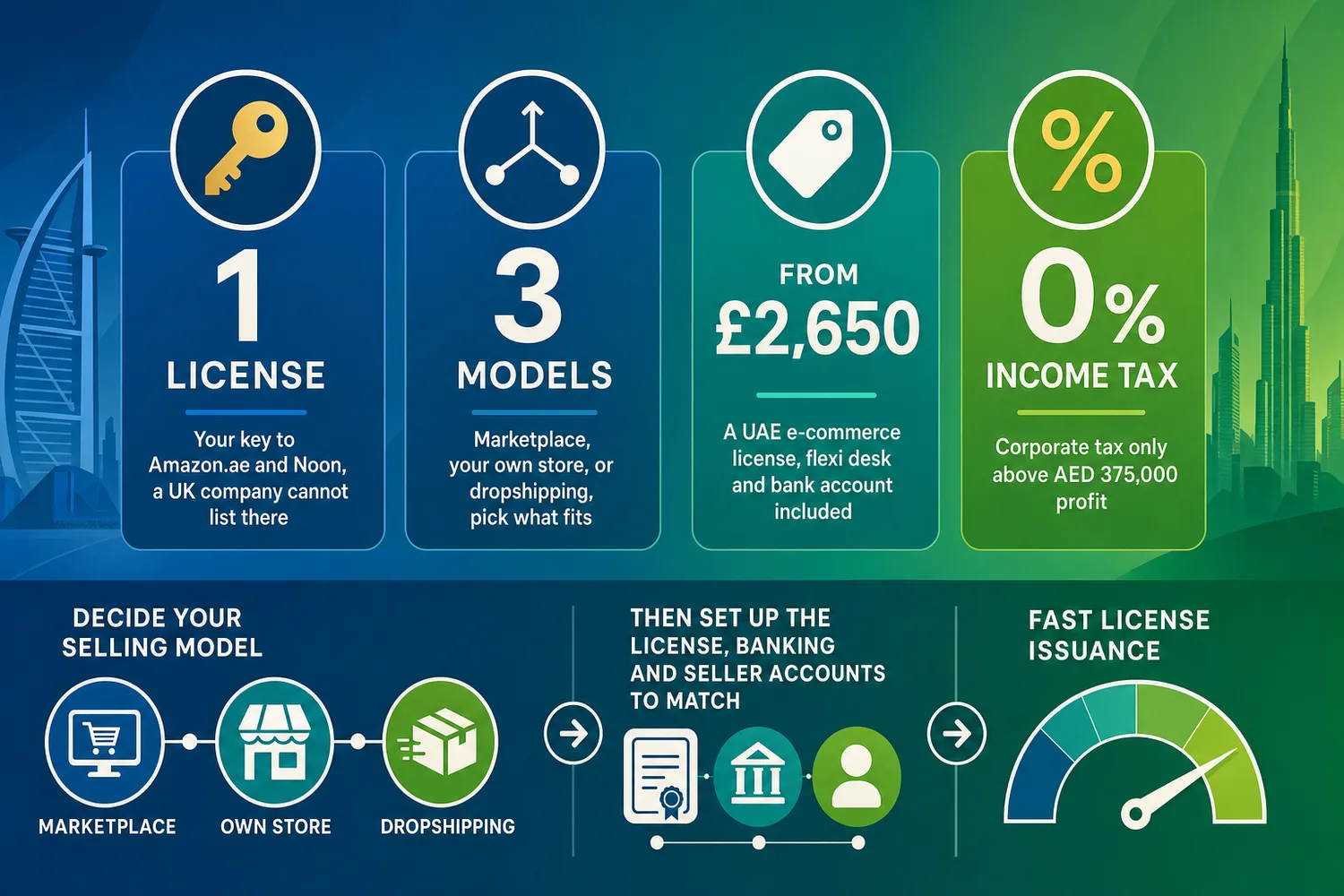
| The blocker | You need a UAE trade license to sell on Amazon.ae or Noon |
|---|---|
| The first decision | Your selling model: marketplace, own store, or dropshipping |
| License cost | From AED 12,500, with a Fawri option in under 60 minutes |
| Getting paid | A multi-currency account holding GBP, AED and USD |
| Personal income tax | 0 percent, with corporate tax only above AED 375,000 profit |
First, the Blocker: Why the UK Company Is Not Enough
Start with the problem, because it decides everything else. If you want to sell inside the UAE, a British company will not get you there on its own.
- Marketplaces are gated: Amazon.ae, Noon and Carrefour UAE all require a valid UAE trade license to onboard as a seller. A UK entity cannot register directly.
- Cross-border selling is clunky: Shipping into the UAE from Britain means customs, duties and slower delivery, which hurts your listings against local sellers.
- Payments and trust suffer: UAE customers expect local payment options and local presence, both of which a UK-only setup struggles to offer.
A UAE e-commerce license removes all three at once. It lets you onboard as a local seller, hold stock in the region, and operate as a UAE business. That is why the license is the starting point, not an afterthought.
Which Selling Model Is Yours?
This is the decision that shapes your whole setup. Most British sellers fit one of three models, and the right license activities depend on which.
| Model | How it works | Best for |
|---|---|---|
| Marketplace seller | List on Amazon.ae and Noon, using their traffic and logistics | Fast entry and reach, at the cost of platform fees |
| Own online store | Sell through your own website, keeping the customer and margin | Brand builders who want control and better margins |
| Dropshipping or hybrid | Sell without holding stock, or mix models | Testing products with low upfront cost |
Free Business Setup Cost Calculator
Calculate NowMany sellers combine models, listing on a marketplace for reach while building their own store for margin. One Meydan Free Zone license holds up to three activity groups, so you can cover e-commerce and related trading activities under a single registration, chosen from more than 2,500 available.
If the marketplace route is yours, Meydan Free Zone's E-commerce Starter service removes the fiddly first step. For AED 1,000, you can:
- Set up seller accounts on two top UAE marketplaces, such as Amazon, Noon or DubaiStore
- List one product on each, professionally and correctly
- Meet each platform's requirements from day one, so you avoid onboarding delays
What It Costs to Start
The setup cost is lower than most British sellers expect. Here is the picture with rough pound figures.
| Item | Cost | Notes |
|---|---|---|
| Regular license | From AED 12,500 (about £2,650) | Issued within a business day, flexi desk included |
| Fawri license | From AED 15,000 (about £3,180) | Issued online in under 60 minutes |
| Bank account | Included via mCore partners | Guaranteed IBAN introduction, multi-currency |
There is no separate office cost, since a flexi desk is bundled into the license, and you can set the whole thing up online before leaving the UK.
Getting Paid Across Borders
A part British sellers often overlook: how the money actually moves. If you are selling in AED but banking in GBP, every payout risks a conversion charge.
This is where a multi-currency account matters. Through Meydan Free Zone's mCore service, you get access to a guaranteed IBAN from one of 26+ partner banks, with accounts that hold GBP, AED and USD together. You collect your UAE sales in dirhams, keep pounds for UK suppliers, and convert only when the rate suits you, rather than losing margin on every transfer between the UK and Dubai.
The Tax Question British Sellers Ask
The most common question is simple: what will I actually pay? The answer is one of Dubai's biggest draws.
- No personal income tax, against a top rate of up to 45 percent in the UK.
- Corporate tax of 9 percent applies only to profits above AED 375,000, so many early-stage sellers pay little or none.
- VAT of 5 percent applies to UAE domestic sales once turnover passes AED 375,000, per the Federal Tax Authority.
One honest caveat: if the company is genuinely run from the UK rather than Dubai, HMRC may treat it as UK-resident for tax. To hold the UAE position, you need real local activity, not just a license on paper.
Setting Up With Meydan Free Zone
Once you know your model, the setup itself is quick and mostly online.
- Choose your activities and name: Pick e-commerce and any trading activities, and run a name check.
- Submit your application: Your passport and form are the core requirements, with no UAE travel at this stage.
- Receive your license: Within a business day through a Regular license, or under 60 minutes with Fawri.
- Open your bank account and start residency: Set up your multi-currency corporate bank account, then arrange your visa and Emirates ID through mResidency.
- Activate your seller accounts: With the license live, onboard on Amazon.ae, Noon or your own store.
Conclusion
For a British seller, the path into the Gulf starts with a single fact: you need a UAE license to sell there properly. Once you accept that, the rest is a set of clear choices, which selling model fits you, how you want to get paid, and the tax you are happy to plan around.
Decide your model first, then set up the license, banking and seller accounts to match. The cost is low, the setup is mostly remote, and the market rewards sellers who commit to it. To price and plan your setup, book a free consultation with a setup advisor at Meydan Free Zone.
Ready to Launch Your Business in Dubai?
Let's Connect