

Table of Contents
Frequently Asked Questions
Can an employer in the UAE deduct money from a salary without the employee's consent?
Only in cases the law lists, such as court-ordered amounts, social security contributions, recovery of advances or overpayments, and approved disciplinary fines. An employer cannot create new deductions through a contract clause. Deductions outside the legal list are unlawful, even if the employee appears to accept them.
Is there a maximum amount an employer can deduct from monthly wages?
Yes. Under Federal Decree-Law No. 33 of 2021 and its executive regulations, total deductions from a worker's wage must not exceed 50% in a month. The cap applies to all deductions combined, not to each item. Any excess must be carried forward and not taken in the same month.
Can a company recover a loan from an employee's final settlement?
Yes, where the employee has acknowledged the loan or advance in writing and the recovery stays within the legal limits. The employer should keep the signed repayment note and show the recovery as a separate line in the final settlement calculation. An undocumented loan is difficult to defend if the employee disputes it.
Are fines for lateness a lawful deduction in the UAE?
A fine is lawful only if it follows an approved penalty schedule and the employee is told the grounds. An informal or verbal fine has no legal basis and can be challenged. The fine must also stay within the monthly deduction cap.
What should a payslip show when a deduction is made?
A payslip should list each deduction as its own line, with the amount and the reason, such as advance recovery or an approved fine. It should also refer to the supporting document, such as a signed repayment note. This record is the first thing MOHRE or a labour court reviews in a wage dispute.
Where can an employee complain about an unlawful wage deduction?
For companies under MOHRE's jurisdiction, the employee can file a wage complaint with MOHRE, which asks the employer to produce its records. Unresolved cases can move to the labour courts. A Meydan Free Zone company should confirm with Meydan Free Zone which complaint route applies to its employees.
Does the Wage Protection System affect how deductions are recorded?
Yes. The Wage Protection System records salary payments electronically, so the net amount paid should match the payslip after lawful deductions. Late or inconsistent WPS files can lead to violations and restrictions on new work permits. Keep each salary file consistent with the payslips for the same month.
Topic Summary
What Salary Deduction Under the UAE Labour Law Means
A salary deduction is an amount an employer withholds from an employee's wage, and only where Federal Decree-Law No. 33 of 2021 and its executive regulations allow it. Deductions outside the listed cases are unlawful, even if the contract or the employee appears to accept them.
Deductions Employers Can Lawfully Make
Lawful deductions include repayment of advances or loans, correction of overpayments, recovery for damage caused by employee error, court-ordered amounts, and disciplinary fines under an approved penalty schedule. Each needs a documented basis and must stay within the legal cap.
Caps, Consent and Documentation Rules
UAE labour law caps total monthly deductions from a worker's wage, and certain categories carry tighter limits. Hold written records of the legal ground, the amount and the employee's acknowledgement before deducting, because MOHRE and the labour courts review that paper trail.
How to Apply a Wage Deduction Correctly
To apply a lawful wage deduction, confirm the legal ground, check the cap, document the amount, notify the employee in writing, show it on the payslip, and pay the net salary through the Wage Protection System on time. Skipping a step invites a dispute or penalty.
Compliance Risks and Penalties Around Wage Deductions
Unlawful deductions can lead to wage complaints at MOHRE, administrative penalties, Wage Protection System violations and referral to the labour courts if disputes escalate further. You may also have to repay the amount. The cost usually exceeds the deduction, so documentation matters more than the sum recovered.
Salary Deductions in a Meydan Free Zone Company
For a Meydan Free Zone company, employee visas are handled through Meydan Free Zone, not MOHRE. Free zones have their own employment regulations, so confirm with Meydan Free Zone how they apply alongside Federal Decree-Law No. 33 of 2021, including the wage payment rules. Either way, lawful and documented payroll practice is a sound benchmark.
What Salary Deduction Rules Mean for Your Hiring Decisions
Treat deductions as a last resort. Clear contracts, advance repayment notes and a documented penalty schedule reduce disputes when an employee leaves or challenges a payslip.
Payroll Deductions Allowed Under UAE Labour Law
Many founders assume a signed employment contract lets them deduct whatever they consider fair from a salary. It doesn't: UAE labour law allows deductions only in listed cases and caps what you can take in a month. Getting this wrong can turn a small recovery into a wage complaint. This guide shows employers how to deduct correctly, or when to decide not to deduct at all.
What Salary Deduction Under the UAE Labour Law Means
A salary deduction is an amount an employer withholds from an employee's wage, and only where Federal Decree-Law No. 33 of 2021 and its executive regulations allow it. Deductions outside the listed cases are unlawful, even if the contract or the employee appears to accept them.
The Legal Basis for Wage Protection
Private-sector employment is governed by Federal Decree-Law No. 33 of 2021, which replaced Federal Law No. 8 of 1980. Wages are protected, and deductions are the exception. The Ministry of Human Resources and Emiratisation (MOHRE) enforces the wage rules for mainland employers.
Say a company uses an old contract template with a "penalty" clause and deducts AED 500 for lateness. The clause doesn't override the statutory list. The deduction is still open to challenge.
Deduction Versus Withholding of Wages
A lawful deduction has a legal ground and a record. Withholding a whole salary without a legal ground is a separate violation. A manager who holds back a month's pay until an employee returns a laptop is withholding, not deducting. In a dispute, that distinction decides who carries the burden.
Deductions Employers Can Lawfully Make
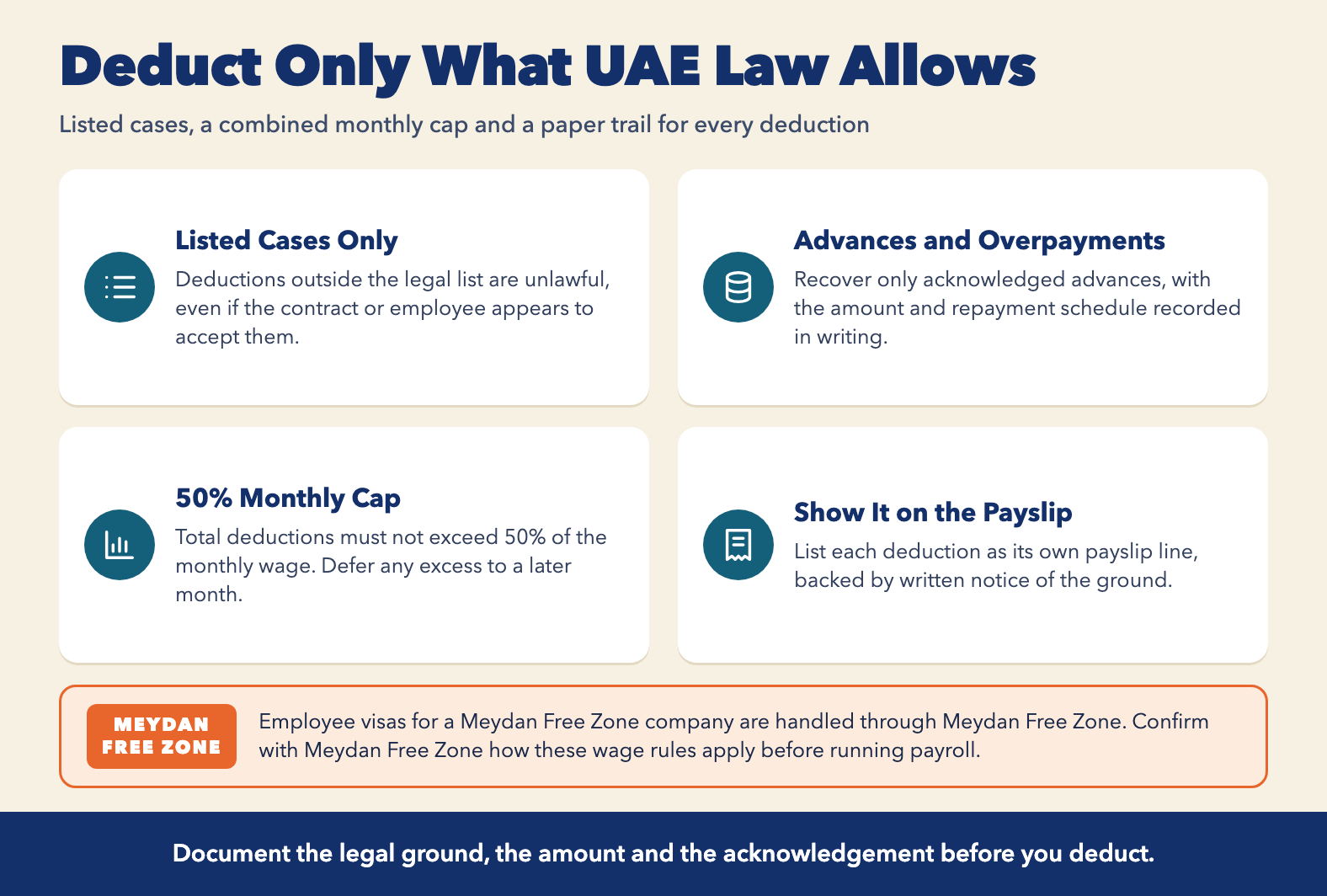
Lawful deductions include repayment of advances or loans, correction of overpayments, recovery for damage caused by employee error, court-ordered amounts, and disciplinary fines under an approved penalty schedule. Each needs a documented basis and must stay within the legal cap.
Advances, Loans and Overpayments
- Recover only advances the employee has acknowledged.
- Correct overpaid wages with a clear calculation.
- Record the amount and repayment schedule in writing.
A startup advances AED 3,000 to a new hire and recovers it over three payroll cycles under a signed repayment note. That works because the paper trail exists.
Disciplinary Fines and Damage Recovery
Fines must follow a penalty schedule approved under the law. Damage recovery applies to loss caused by the employee's own error or breach. The employee must be told the grounds. A logistics firm recovering part of a repair bill for equipment damaged through documented negligence is on firm ground. Without the documentation, it isn't.
Statutory and Court-Ordered Amounts
Where an employee is covered by social security, contributions are deducted as required. A court order may also direct part of a wage towards a debt. In both cases you act on legal instruction, not discretion.
Caps, Consent and Documentation Rules
UAE labour law caps total monthly deductions from a worker's wage, and certain categories carry tighter limits. Hold written records of the legal ground, the amount and the employee's acknowledgement before deducting, because MOHRE and the labour courts review that paper trail.
Monthly Limits on Total Deductions
Under Federal Decree-Law No. 33 of 2021 and its executive regulations, total deductions from a monthly wage must not exceed 50%. The limit applies to all deductions combined, not per item. Some items carry lower limits, such as court-ordered debts at 25% of the wage and damage recovery at five days' wages a month. If two deductions overlap and breach the cap, defer the excess to a later month.
Written Records That Protect the Employer
- Written notice of the ground for deduction.
- Signed acknowledgement for advances.
- A payslip showing each deduction line.
A payslip that lists "advance recovery" with a reference to the signed note heads off many arguments before they start. If grievances do arise, see these employee grievance procedures.
How to Apply a Wage Deduction Correctly
To apply a lawful wage deduction, confirm the legal ground, check the cap, document the amount, notify the employee in writing, show it on the payslip, and pay the net salary through the Wage Protection System on time. Skipping a step invites a dispute or penalty.
Steps to Follow Before Deciding on a Deduction
- Identify the legal ground in the labour law.
- Check the cap against deductions already made that month.
- Record the amount and reason in writing.
- Notify the employee before payroll closes.
- Show the deduction on the payslip.
An HR lead recovering an overpayment from a sales executive should run all five before payroll closes.
Where Payroll Errors Usually Start
Verbal agreements, uncapped deductions and late file uploads are common causes of errors. A small trading company that deducts a fine in cash leaves no record on the payslip, and that's exactly what an inspector looks for. Read how the Wage Protection System handles salary files.
Compliance Risks and Penalties Around Wage Deductions
Unlawful deductions can lead to wage complaints at MOHRE, administrative penalties, Wage Protection System violations and referral to the labour courts if disputes escalate further. You may also have to repay the amount. The cost usually exceeds the deduction, so documentation matters more than the sum recovered.
What Happens When an Employee Complains
The complaint goes through MOHRE, which asks you to produce records. Say an employee disputes a AED 1,500 fine and you can't produce a penalty schedule. The fine is likely to be reversed. Unresolved cases move on to court, as covered in this guide to labour disputes in Dubai.
Common Payroll Deductions and Their Documentation Needs
| Deduction type | Documentation needed |
|---|---|
| Salary advance or loan recovery | Signed repayment note with amount and schedule |
| Overpayment correction | Payroll calculation showing the error, plus written notice |
| Disciplinary fine | Approved penalty schedule and written notice of the grounds |
| Damage recovery from employee error | Incident report, repair or loss evidence, and written notice |
| Court-ordered amount | Copy of the court order held on file |
Penalty Exposure for Employers
Exposure includes administrative fines, repayment of unlawful deductions and Wage Protection System restrictions. Repeated violations can limit new work permits. See the wider consequences of non-compliance in the UAE.
Salary Deductions in a Meydan Free Zone Company
For a Meydan Free Zone company, employee visas are handled through Meydan Free Zone, not MOHRE. Free zones have their own employment regulations, so confirm with Meydan Free Zone how they apply alongside Federal Decree-Law No. 33 of 2021, including the wage payment rules. Either way, lawful and documented payroll practice is a sound benchmark.
Jurisdiction and Which Rules Apply
Federal law and free zone responsibilities aren't the same thing. A founder with a Meydan Free Zone license should set deduction terms in the employment contract before the first hire. Read more on Dubai labour law and Meydan Free Zone.
Records That Make a Deduction Defensible
Accurate payslips and records make a deduction defensible. A two-person consultancy can show each deduction line on its payslips. Meydan Plus keeps services separate: mAccounting covers bookkeeping, VAT registration support and Corporate Tax support, while residence visas for employees sit under mResidency.
Free Business Setup Cost Calculator
Calculate NowWhat Salary Deduction Rules Mean for Your Hiring Decisions
Treat deductions as a last resort. Clear contracts, advance repayment notes and a documented penalty schedule reduce disputes when an employee leaves or challenges a payslip.
Contract Terms to Settle Before the First Hire
- Advance and loan repayment terms.
- Penalty schedule, where you use one.
- Equipment return and responsibility clause.
Settling these early also simplifies final payments, covered in this guide to end of service benefits.
Conclusion
Wage deductions under UAE labour law are narrow by design. Stay within the listed cases, respect the monthly cap and keep written records. A clean payslip and a signed note carry more weight than any contract clause. For a Meydan Free Zone company, employee visas run through Meydan Free Zone, so confirm with it how these wage rules apply before your first payroll run.
Ready to Launch Your Business in Dubai?
Let's Connect